
In the construction of small-size FPV drones, the 1404 motor is a common brushless motor specification, frequently utilized in lightweight configurations primarily using 3-inch propellers. Centered around this specification, practical application often involves issues of motor positioning, applicable scenarios, and compatibility with components such as propellers, ESCs, and batteries. This article will focus on the basic definition and usage characteristics of 1404 motors, combined with actual assembly scenarios, to systematically explain suitable flight types, common pairing methods, and the differences between similar motor specifications, helping readers establish a clear and actionable understanding of selection and usage.
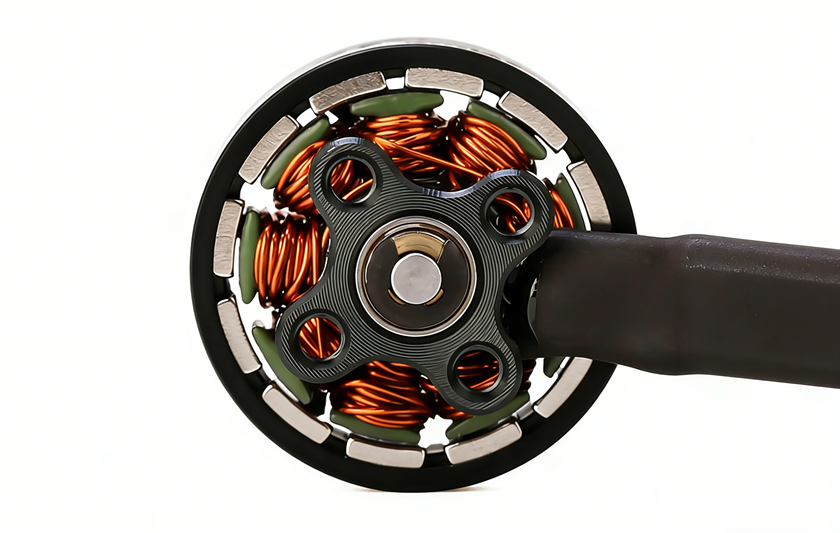
Basic Introduction to 1404 brushless Motors
Before entering specific selection criteria, it is necessary to establish a basic understanding of the 1404 motor. This chapter only answers two questions: what is a 1404 motor, and what characteristics does it typically possess?
1. What is a 1404 Motor?
The 1404 motor is a common FPV brushless motor specification distinguished by its stator size. "14" represents the stator diameter, and "04" represents the stator height. This naming convention is used to describe the physical volume of the motor; it does not in itself directly represent power output or performance levels.
In practical use, 1404 motors are most commonly seen in small FPV drones, especially in builds utilizing 3–4 inch propellers. It sits between micro motors and medium-sized motors, serving as a specification frequently used by many players pursuing lightweight design and control feel.
It should be noted that even for motors both labeled as 1404. significant differences in flight performance may still exist between different brands and different KV values. Therefore, "1404" is more of a definition at the dimensional level rather than a direct guarantee of flight performance.
2. Characteristics of the 1404 Motor
From the perspective of actual FPV flight experience, the core characteristic of the 1404 brushless motor lies in its overall balance. It is neither as prone to feeling underpowered as smaller specifications nor as prone to significantly increasing weight as larger specifications; its impact on the overall handling of the aircraft is relatively moderate.
During flight, 1404 motors typically possess fast response speeds, making the aircraft easier to control during acceleration and attitude changes. This makes it more suitable for daily freestyle, racing/cruising, and playstyles that emphasize control feel, rather than scenarios specifically intended for high loads or sustained high-throttle output.
At the same time, because the volume and weight are well-controlled, the 1404 motor is relatively friendly regarding the tolerance for the overall tuning of the aircraft. When reasonably paired with propellers, batteries, and ESCs, one can often obtain a stable and smooth flight experience, which is also the reason it is frequently used in small-size FPV builds.
What Flight Scenarios are 1404 Motors Suitable For?
The most effective way to judge whether a motor is suitable is not simply to look at parameters, but to see whether it runs smoothly in specific flight scenarios. For the 1404 motor, its applicable scenarios are actually very clear, though they are often misused or over-expected.
Use Case | Is 1404 Suitable? | Explanation |
Lightweight 3" FPV build | Highly suitable | Best balance of control and responsiveness |
Lightweight 3.5" build | Conditionally suitable | Requires careful control of prop load and total weight |
High-load 4" build | Not recommended | Approaches the comfort limit of 1404 motors |
Smooth freestyle / cruising | Suitable | Linear throttle response and good controllability |
Sustained high-throttle flying | Not suitable | Increased thermal and efficiency stress |
Heavy frame or multiple add-ons | Not suitable | Larger motor sizes handle load more comfortably |
1. Daily Flight Scenarios for Small FPVs
In actual use, the most common application scenario for the 1404 brushless motor is small FPV drones paired with 3–4 inch propellers. These types of builds usually emphasize lightweight design, flexibility, and control feel, rather than sustained high-thrust output.
Under such configurations, the 1404 motor is often able to provide a sufficiently direct power response while not significantly increasing the overall weight of the aircraft. The aircraft is easier to control during acceleration, turning, and attitude adjustments, and the overall flight feel tends to be light and crisp. This is why many daily freestyle or cruising players treat the 1404 as a relatively worry-free choice.
2. Flight Scenarios Requiring Control Feel and Responsiveness
If your flight requirements lean more toward control feel rather than simply pursuing thrust data, the 1404 motor will typically better meet expectations. Its response to throttle changes is relatively direct; the aircraft will not feel sluggish, nor is it prone to a noticeable sense of inertial drag.
This characteristic is particularly evident in scenarios such as flying in tight spaces, proximity flying , or scenarios requiring frequent attitude adjustments. Compared to larger specification motors, the control feedback brought by the 1404 motor is more linear and easier to adapt to. For users who hope for controllable flight, this is a very important advantage.
3. Flight Scenarios Unsuitable for 1404 Motors
It is important to note that the 1404 brushless motor is not designed for all scenarios. When the overall load of the aircraft gradually increases, or when a high throttle output is maintained for a long period, it will often begin to struggle.
This situation does not necessarily manifest as a lack of power, but is reflected in increased heat, decreased efficiency, or a flight feel that is no longer effortless. If your usage scenario leans more toward high-load configurations, or if you hope to maintain composed power performance under larger propellers and higher output, then continuing to use the 1404 motor is often not the most suitable choice. This is the reason why many users, after using it for a period, begin to pay attention to 1408. 1505. or even larger specification motors.
1404 Motor Matching Guide
If you choose a 1404 motor to assemble an FPV drone, whether it is your first time building or you already have certain flight experience, a basic judgment must be established first: the 1404 is a motor with a lightweight and control-oriented orientation; it is not suitable for being pushed to extreme working conditions.
Therefore, when pairing propellers, ESCs, batteries, and KV, the goal is not merely to be "sufficient," but to allow the entire system to stay within a relatively relaxed and controllable working range for the long term.
Component | Recommended Range | Notes |
Propeller size | 3" (most reliable) | Best balance of load, temperature, and response |
ESC rating | ≥20A (25A preferred) | Extra headroom improves stability and thermals |
Battery voltage | 3S / lightweight 4S | 4S requires coordinated prop and KV adjustments |
KV selection | Moderate, stability-oriented | Avoid excessively high KV under heavy load |
Flying style | Control-focused, smooth | Not intended for sustained high-throttle output |
1. Matching 1404 Motors with Propellers
In real assembly experience, the most mature and worry-free pairing for the 1404 brushless motor is the 3-inch propeller. At this size, the weight and load of common propellers are within the range that the 1404 motor can handle relatively easily. The motor is not prone to noticeable struggle or excessive temperature rise during acceleration, sudden stops, and continuous operations.
When the propeller size approaches 3.5–4 inches, the situation changes. The aircraft can still take off and fly normally, but after continuous high throttle or frequent rolls, the motor temperature rise will be more obvious, and the response will become relatively sluggish. This is not to say that the 1404 motor cannot carry a 4-inch propeller, but rather that the propeller load has gradually approached its upper limit of comfort.
Therefore, if using a 4-inch propeller, the load of the propeller itself must be controlled simultaneously—for example, by choosing lighter propellers or lower pitches, and maintaining more conservative choices in subsequent voltage and KV selection. Otherwise, even if it can fly for a short time, long-term use is prone to heat issues and efficiency degradation.
2. Matching 1404 Motors with ESCs
In 1404 motor configurations, the ESC is the link most likely to expose problems later on. Many instances of temperature rise, inconsistent response, or occasional desync occurring during flight are not problems with the motor itself, but are the result of the ESC working in a high-load state for a long time.
In common 3–4 inch FPV builds, the instantaneous current of the 1404 brushless motor during sudden acceleration and stops is not low. If the rated current of the ESC is only theoretically "just enough," then after continuous flight, stability and temperature control will often begin to decline.
From the perspective of the safety margin for actual assembly, 20A can serve as a usable starting point, but if you hope for a more stable flight state and more composed temperature control, a 25A-level ESC will be significantly more reliable. When using 4S batteries or high-load propellers, the more sufficient the ESC margin, the less likely the system is to develop hidden problems.
3. 1404 Motor and Battery Voltage Selection
Battery voltage directly affects the RPM, current changes, and temperature state of the 1404 brushless motor, rather than just being a difference in power magnitude. Under different voltages, the personality of the 1404 motor undergoes very obvious changes. In actual FPV construction, a 3S battery is a very reliable choice. At this voltage, it is easier to achieve a balance between response, temperature, and controllability for the 1404 motor; requirements for propellers and ESCs are also relatively moderate, and the overall tolerance is higher.
4S batteries are also very common in lightweight 1404 builds, especially in 2.5–3 inch lightweight freestyle or cinewhoop scenarios. However, it must be clarified that 4S will significantly increase RPM and peak current, which means the propeller load, KV, and ESC margin must all be adjusted simultaneously. If one continues to use oversized propellers or excessively high KV under 4S conditions, the most direct result is a rapid increase in heat and throttle control becoming tense.
In comparison, 2S battery output is relatively mild, making it more suitable for endurance-oriented or slower-paced flight scenarios, though it is not often the first choice in mainstream FPV use.
4. KV Value Selection for 1404 Motors
KV is the parameter most easily misunderstood in 1404 brushless motor selection. It is not a power level, but rather an indicator that determines the speed of RPM change for the motor at a certain voltage. In other words, KV will amplify the overall orientation of your current pairing, rather than determining the flight experience on its own.
Under a 4S configuration, the mainstream KV range for 1404 motors usually falls between 3800–5000 KV. Among these, for lightweight 2.5–3 inch builds, common KVs will be closer to 4500–5000; if the propeller load is slightly higher, or if you want better temperature control, a KV closer to 3800–4200 will be more reliable.
Under a 3S configuration, because the voltage is lower, the common KV for 1404 motors will be significantly higher. It is not rare to see configurations around 6000 KV, especially in lightweight, small propeller, or whoop-style play. These types of configurations are not abnormal; they simply have a different orientation.
What needs to be avoided is: continuing to choose an excessively high KV under the premise of high voltage and high-load propellers. What this brings is often not a better flight experience, but rather faster temperature rise and a control feel that is no longer linear.
IV. Comparison of 1404 with 1408. 1505. and 1604 Motors
1. Differences Among the Four Motors
When building an FPV drone or upgrading specifications, the 1404 is usually compared with similar specifications like the 1408. 1505. and 1604. Rather than simply comparing parameter sizes, it is more important to understand their differences in actual use and their respective suitable configuration conditions.
Among these specifications, the 1404 is more suitable for lightweight construction plans. It is commonly found in 3-inch-ish configurations. When the overall weight is controllable and the propeller load is not too high, the response is direct and the control is relatively stable. For daily flight, racing, and smoother freestyle scenarios, the 1404 often yields a relatively balanced flight state without complex adjustments. However, when the load gradually increases, one needs to maintain temperature and feel by reducing propeller load (压桨), lowering KV, or controlling voltage.
The 1408 can be understood as having enhanced load adaptability on the basis of the 1404. The increase in stator height gives it better torque and sustained output performance under 3.5–4 inch propeller conditions. When the 1404 starts to approach its upper limit of comfort in a current configuration, but one does not wish to significantly increase weight, the 1408 is often a more suitable transitional choice, as its stability under high load is generally better.
The positioning of the 1505 leans more toward a high-margin configuration. It is very common in 2.5–4 inch micro freestyle, especially under 4S conditions. When the aircraft is relatively heavy and the flight style is more aggressive, the 1505 can reduce restrictions on propellers and throttle, allowing the system to run more composedly. Choosing the 1505 is more about obtaining power margin rather than simply pursuing a larger propeller size.
The 1604 is more commonly used in sustained output scenarios for 3.5–4 inches. In sub-250g 3.5-inch power builds or lightweight 4-inch configurations, the 1604 can reduce the long-term working pressure on the motor while the weight remains acceptable. Compared to continuing to use the 1404 in these scenarios, the 1604 makes it easier to maintain stable temperature and output states.
Overall, the 1404 is suitable for lightweight, control-focused configurations; the 1408 is used to improve load capacity at a similar weight; the 1505 leans toward high margin and more aggressive flight styles; and the 1604 is better suited for builds requiring sustained output under 3.5–4 inch conditions.
2. Quick Comparison Table for the Four Motors
Motor Size | Core Positioning | Typical Prop Size Range | Common Use Scenarios | Why Choose It |
1404 | Lightweight, control-focused | Mainly 3" (lightweight 3.5" also common) | Daily flying, cruising, smooth freestyle | Low weight, fast response, excellent controllability when properly matched |
1408 | Same diameter, higher load tolerance | 3.5"–4" | Higher-load 3.5–4" builds needing better thermal stability | Improved torque and sustained output while remaining agile |
1505 | Power headroom & punch | 2.5"–4" (most common in 3–4" micro freestyle) | 4S micro freestyle, heavier builds, aggressive flying styles | Reduces the need to limit props or throttle to maintain temperature and control |
1604 | Enhanced sustained output for 3.5–4" | 3.5"–4" | Sub-250g 3.5" or lightweight 4" power builds | Significantly improves efficiency and output margin with manageable weight increase |
Common Selection Pitfalls for 1404 Motors
In actual assembly, problems with the 1404 motor often do not stem from the specification itself, but from it being used in unsuitable system conditions. The following situations almost all come from real assembly and test flight feedback.
1. Only Looking at Propeller Size, Ignoring Overall Weight
Many users, when choosing a 1404 brushless motor, only focus on whether it is a 3-inch propeller, while ignoring that the overall weight of the aircraft is already significantly heavy. When the frame, video transmitter, battery, and protective parts are stacked one by one, even if the propeller size looks reasonable, the motor may already be in a high-load state for a long time during actual flight.
A very intuitive signal is: you need to noticeably reduce propeller load, reduce KV, or limit throttle to barely make the temperature and feel normal. This usually indicates that the problem is no longer with the parameters, but with whether the specification matches.
2. Selecting ESC at the Lower Limit, Working in High Load for Long Terms
In 1404 motor configurations, the situation where the ESC is underestimated is very common. Many machines perform normally during short test flights, but after continuous flight, they begin to experience high motor temperatures, inconsistent response, or even occasional desync.
These types of problems often stem from the ESC working close to its rated current for a long time, rather than the motor itself. As long as more margin is reserved for the ESC, stability and temperature control will usually show significant improvement.
3. Upgrading Voltage Without Synchronously Adjusting Propellers and KV
Upgrading from 3S to 4S is a common operation, but if only the battery is replaced while the propeller load and KV remain unchanged, problems will usually appear quickly. Takeoff and acceleration are indeed more powerful, but at the same time, the motor temperature rises faster, and control tolerance will significantly decrease.
In assembly practice, a voltage upgrade must be regarded as a system-level adjustment. As long as the voltage is increased, one needs to simultaneously check propeller load, KV, and ESC margin; otherwise, the 1404 motor is easily pushed into a position that is not suitable for it.
4. Chasing high KV, ignoring sustained flight
High KV indeed brings more direct response, but it also amplifies current and temperature issues. Many cases of heating up within a short time are not due to insufficient motor performance, but because the KV further amplified an already high load. In fact, if one must rely on high KV to feel that the plane is easy to fly, it often indicates that the overall configuration itself is not balanced.
5. Blindly Copying Others' Configurations, Ignoring Own Usage Scenarios
Copying configurations is very common in the FPV circle, but many shared parameters only hold true under specific frame weights and flight styles. It is not surprising that the same 1404 brushless motor, battery, and KV show significant differences in flight performance when moved to a different frame or payload.
For the 1404 motor, scenario adaptation is often more important than parameter consistency. It is not a universal specification, but under the right conditions, it almost never disappoints.
Why Does the Flight Experience of 1404 Motors From Different Brands Differ Greatly?
In actual assembly, many users encounter this phenomenon: the specifications, KV, voltage, and propellers are almost identical, but simply changing the brand causes the flight feel of the 1404 motor to undergo obvious changes. Some respond more crisply, some are smoother, some are more prone to heating, and some have more composed temperature control.
This difference is not a psychological effect, but is caused by a series of real-world design and manufacturing factors working together.
1. Differences in Motor Weight and Moment of Inertia
Under the same 1404 motor specification, different brands have different orientations in their design of weight and moment of inertia. Some designs emphasize lightweighting to reduce the moment of inertia and improve RPM response; others trade for more stable operating characteristics through a relatively higher mass distribution.
This difference directly affects flight performance. Motors with a lower moment of inertia react faster to RPM changes but are more sensitive to load and current fluctuations; designs with a higher moment of inertia have more advantages in sustained output and attitude stability. Therefore, the difference in weight and moment of inertia is not a matter of superior or inferior performance, but a design choice for different usage scenarios and flight orientations.
2. Winding Methods and Magnetic Circuit Design
Winding methods and magnetic circuit design are among the core factors determining the difference in flight experience for 1404 brushless motors. Different brands do not have identical orientations in winding density, wire gauge selection, and magnet layout.
In actual use, motors with windings and magnetic circuits more oriented toward efficiency and torque usually perform more composedly in the low-to-medium RPM range, making them suitable for continuous flight and stable output; whereas designs more pursuing response will be more sensitive during throttle changes, but are also more likely to amplify load problems already existing in the system. This is why, under the same configuration conditions, some 1404 motors are more suitable for smooth freestyle, while others lean more toward short, intense operation styles.
3. Shafts, Bearings, and Assembly Precision
The quality of shafts and bearings, as well as assembly precision, are factors that many users easily overlook but which have a large impact on the flight experience. Bearing damping, concentricity, and assembly consistency all directly affect the smoothness and noise level of the motor.
In assembly practice, these types of differences are often reflected in details, such as the feel of the motor during idling, the amount of subtle jitter during flight, and the change in state after long-term use. Some 1404 motors feel very good initially, but after a period of use, noise and damping increase significantly; while others are more durable, and the flight feel can be maintained for longer.
4. Different Design Orientations
It needs to be emphasized that the differences between 1404 brushless motors of different brands do not equate to who is better or worse. In more cases, it is simply a difference in design orientation. Some brands' goal is ultimate lightweighting and response, while others value stability, lifespan, and consistency more.
When users frequently change motor brands without changing the flight scenario, it is easy to produce the conclusion that "this motor is no good"; however, from an assembly perspective, a more reasonable way to judge is: whether the design orientation of this 1404 motor matches your usage scenario and overall pairing method.
Frequently Asked Questions (FAQ)
Q1. Is the 1404 motor suitable for a beginner's first FPV assembly?
Under a configuration centered on 3 inches with reasonable overall weight control, the 1404 motor is relatively friendly to beginners. As long as high-load and aggressive parameter combinations are avoided, its controllability and stability are both relatively easy to master. However, it is not suitable for beginner configurations where parameters are piled up randomly.
Q2. Can I mix 1404 motors of different KVs on the same FPV?
Mixing is not recommended. Different KVs will bring differences in RPM and response, increasing the difficulty of tuning and even affecting flight stability. If you need to change the KV, it is recommended to replace the entire set of motors at the same time.
Q3. Is the 1404 motor suitable for cinewhoops or models with protective ducts?
It can be used in lightweight 2.5–3 inch cinewhoop scenarios, but the premise is strict control of overall weight and propeller load. For relatively heavy configurations, the 1404 motor will often expose temperature rise and efficiency problems earlier.
Q4. Can throttle limiting solve load problems in the long term?
Throttle limiting can serve as a temporary mitigation measure, but it is not suitable as a long-term solution. If you must rely on long-term throttle limiting to fly stably, it often indicates that the motor specification or the overall pairing does not match the usage scenario.
Q5. Is the 1404 motor more suitable for smooth flight or aggressive flight?
The 1404 motor leans more toward control and sense of rhythm, suitable for smooth freestyle and cruising flight. It can be used in sustained high-throttle, aggressive action scenarios, but requirements for pairing and parameters are higher.
Q6. Is it normal for the flight feel to deteriorate after a period of use?
After experiencing impacts or long-term use, bearing wear may lead to increased noise or decreased smoothness. After confirming that the propellers and frame are normal, you should focus on checking the state of the bearings.
Q7. When should I consider upgrading specifications from the 1404 motor?
When the configuration is in a high-load state for a long time, or when you need to frequently "dial back"parameters to maintain stability, you should consider a larger specification motor rather than continuing to force the use of the 1404 motor.
Further reading:
Small Drone Motors Selection Guide(1–5 Inch FPV 2025)
Previous Post : Drone Frame Size Chart and Selection Overview