
When choosing a drone motor, the term 1kg thrust motor often comes up. For many people, seeing this specification for the first time leads to a natural assumption: if a motor is rated at 1kg of thrust, it must be quite powerful, and the number can be used directly to judge how much weight a drone can carry.
In practice, things are rarely that simple. Even motors that are all labeled as 1kg thrust can behave very differently in flight. Some can only approach this figure at high throttle, while others reach it with noticeably less effort. Some draw significantly more power, while others deliver a smoother and more stable flight experience.
This is why relying solely on the “1kg thrust” number can easily lead to misunderstandings. To properly judge whether a 1kg thrust motor is suitable for a particular drone, it is essential to understand how this thrust value is measured and how it should be interpreted in real use.
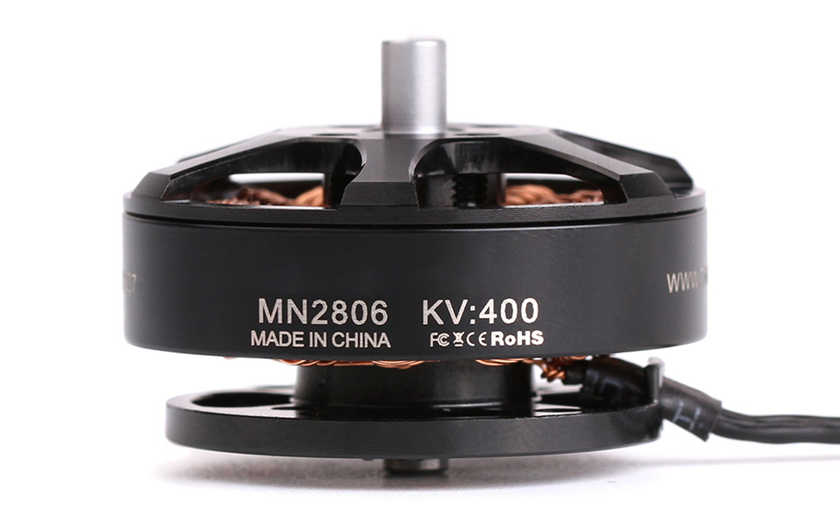
What Does 1kg Thrust Really Mean for a Drone Motor?
In motor specifications, a 1kg thrust rating usually indicates that, under specific test conditions, the motor is capable of producing upward force roughly equivalent to the weight of 1.000 grams.
One important detail is often overlooked: this value is almost always obtained through static thrust testing. During such tests, the motor is fixed on a test stand with no forward airflow. It is run at a specified voltage, paired with a specific propeller, and typically operated at relatively high throttle while its thrust output is measured.
The advantage of this method is that the results are clear and make it easier to compare different motors. However, static testing does not reflect actual flight conditions. In real flight, airflow, speed, and attitude are constantly changing, and the operating behavior of the motor and propeller changes with them. As a result, a measured 1kg thrust value is better understood as a reference upper limit, rather than an output level that will be used continuously during flight.
It is also worth noting that test conditions vary between manufacturers. Differences in test voltage—such as 4S versus 6S—as well as propeller size and pitch can significantly affect the final thrust figure. This explains why two motors, both labeled as 1kg thrust, may feel completely different once they are in the air.
Is 1kg Thrust a Peak Number or Something You Can Actually Use?
When a motor is described as a 1kg thrust motor, a common question follows: is this thrust level merely a rated maximum, or something that can be used regularly during flight?
In most cases, it is closer to the former. A 1kg thrust rating typically represents the maximum output a motor can achieve under test conditions, not a level intended for sustained operation. Reaching this thrust usually requires high throttle input, along with a noticeable increase in current draw and power consumption.
For short moments—such as takeoff, rapid climbs, or brief bursts of acceleration—operating near 1kg thrust is generally not a problem. However, holding this level for extended periods often leads to a less comfortable flying experience. Motor temperatures rise more quickly, efficiency drops, and the overall power system is placed under greater stress.
In everyday flight, most drones rarely need to sustain such high thrust. During hovering or normal cruising, motors typically operate at only a fraction of their available capacity. Leaving some thrust headroom tends to make the aircraft feel calmer and more controllable overall.
What 1kg Thrust Actually Means in Different Contexts:
Context | What “1kg Thrust” Refers To | Practical Impact on Motor Selection |
Specification listing | Maximum static thrust measured under specific test conditions | Useful for comparing motor capability, not direct flight performance |
Test conditions | Motor fixed in place, no forward airflow, near high load | Represents an upper capability limit rather than normal operation |
Real-world flight | Thrust level rarely sustained during typical flight | How comfortably the motor reaches this level matters more than the number |
Selection decision | A reference point for motor capacity | Choosing motors with headroom leads to better overall performance |
What Motor Sizes Can Typically Deliver 1kg Thrust?
Once the target is around 1kg of thrust per motor, the relevant range of motor sizes becomes easier to define. While motors of various sizes can approach this level under suitable configurations, the conditions under which they do so can differ significantly.
Some motors need to be pushed close to their limits to reach 1kg thrust, while others achieve the same output with far less strain. Understanding these differences helps set more realistic expectations during motor selection, rather than focusing solely on whether a motor can technically reach the number.
1.Stator Sizes That Can Get Close to 1kg Thrust
Among commonly used brushless motors, 22xx-size motors can often approach or even reach 1kg thrust when paired with appropriate voltage and propellers. In these setups, however, the motor is usually operating under relatively high load, which places greater demands on throttle control and overall system tuning.
23xx-size motors represent a more balanced and commonly used range for achieving 1kg thrust. With sensible configurations, motors in this class can approach the target thrust more consistently while still retaining some headroom. This balance is why they are widely used across many drone platforms.
For 28xx-size motors and above, reaching 1kg thrust generally feels much easier. In these cases, 1kg thrust often represents only a portion of the motor’s total capability rather than a near-limit condition. The trade-off, of course, is increased motor size and weight.
These size ranges are only general guidelines. Actual performance still depends on motor design, KV rating, and the overall power system. Even so, motor size plays a major role in determining how hard a motor has to work to reach 1kg thrust.
How Different Motor Sizes Behave Near 1kg Thrust:
Motor Size Range | Typical State Near 1kg Thrust | Thrust Characteristics | More Suitable Use Cases |
22xx | Close to performance limit | Requires high throttle and careful tuning | Lightweight builds or short burst output |
23xx | Within main operating range | Balanced thrust and usable headroom | General-purpose drone setups |
28xx and above | Well below maximum capability | Thrust delivered with less stress | Stability-focused or long-term reliability |
2.What KV Range Works Best for a 1kg Thrust Motor?
Beyond motor size, the KV rating also influences how a 1kg thrust motor produces its output. A common misconception is that higher KV automatically makes it easier to achieve higher thrust. In reality, the relationship is more nuanced.
Higher-KV motors tend to rely on higher rotational speeds to generate thrust. When approaching 1kg thrust, this often means higher throttle positions and increased current draw. Lower-KV motors, by contrast, typically achieve similar thrust by spinning larger propellers at lower speeds.
This helps explain why many pilots feel that pairing lower-KV motors with a 6S power system results in a more relaxed operating state. The motor does not need to spin as fast to approach 1kg thrust, which generally reduces overall stress. As a result, there is no simple rule that higher KV is better. KV mainly determines how a motor reaches 1kg thrust, not whether it can reach it.
Voltage and Propeller Choices for Reaching 1kg Thrust
When aiming for 1kg thrust, the motor itself is only part of the system. Supply voltage and propeller selection often play a decisive role in how easily this thrust level is reached and how the drone behaves in flight.
Many configurations that appear similar on paper can feel very different in practice. The difference usually comes down to how voltage and propeller choices interact with the motor, determining whether the system operates near its limits or with relative ease.
1. 4S vs 6S: What’s the Difference When Aiming for 1kg Thrust?
On a 4S system, approaching 1kg thrust typically requires higher motor speeds. This usually involves higher throttle positions and increased current draw, placing more demand on the battery and the rest of the power system.
On a 6S system, the same thrust can often be achieved at lower motor speeds and throttle levels. For many users, this results in smoother behavior and lower overall system stress. This is why, when targeting 1kg thrust, 6S setups are often described as feeling more relaxed. This does not mean 4S is unsuitable, only that higher voltage allows the same thrust to be reached with less effort.
4S vs 6S Systems When Approaching 1kg Thrust:
Comparison Aspect | 4S System | 6S System |
How 1kg thrust is achieved | Relies on higher motor speed and throttle | Achieved at lower motor speed |
Current draw and system stress | Generally higher | Generally lower |
Operating load region | Near high-load range | Mid-to-high load range |
Subjective flight feel | More strained | Smoother and more relaxed |
2.What Propeller Sizes Are Commonly Used for 1kg Thrust?
The propeller directly converts motor output into thrust, making it a key factor in how 1kg thrust is achieved. As target thrust increases, propeller size typically increases as well.
In many common setups, propellers of 5 inches and larger are more likely to approach 1kg thrust under appropriate conditions. Larger blades move more air at lower speeds, which helps generate higher thrust.
Propeller pitch is equally important. While higher pitch can increase thrust potential, it also raises motor load and power consumption. Simply switching to a larger propeller is not a universal solution. In practice, achieving 1kg thrust depends on the combined interaction of motor, voltage, and propeller, rather than on any single component alone.
Common Motor Setup Examples for Around 1kg Thrust
When discussing 1kg thrust motors, focusing on a single specification rarely reveals the full picture. A more realistic approach is to consider the entire setup: how motor size, KV, voltage, and propeller work together.
The following examples are not specific model recommendations, but common configuration approaches. They focus less on whether 1kg thrust can be reached, and more on how it is typically achieved under different priorities.
1.Burst-Power FPV-Oriented Setups
In FPV-oriented builds, 1kg thrust is often treated as a momentary capability rather than a sustained operating point. These setups emphasize responsiveness and burst power, allowing rapid climbs and aggressive attitude changes when needed.
A typical approach uses mid-sized motors with relatively high KV, relying on higher throttle to generate thrust. With suitable voltage and propellers, such systems can approach or reach 1kg thrust, but they usually operate in a higher output range. In this context, 1kg thrust represents a performance ceiling rather than a regularly used state.
2.Efficiency-Focused Multirotor Setups
In efficiency- and stability-focused multirotor setups, 1kg thrust is generally viewed as capacity headroom. These systems prioritize smooth operation and efficiency at lower thrust levels rather than short bursts of power.
A common approach is to use slightly larger, lower-KV motors paired with higher-voltage systems. Under these conditions, approaching 1kg thrust does not require extreme motor speeds, and the overall operating state remains more stable. In this case, 1kg thrust is not a routine flight target, but a safety margin for handling load changes or unusual situations.
3.Lower-Stress, More Conservative Setups
For applications where reliability is a higher priority, configuration choices tend to be more conservative. These setups often use larger motors so that 1kg thrust falls well within the lower portion of the motor’s capability range.
The advantage is reduced stress at the same thrust level and more relaxed operation overall. While motor size and weight increase, the result is often more consistent and predictable performance. Here, 1kg thrust is best understood as a readily available capability rather than a performance limit.
How Much Thrust Headroom Should You Leave?
A common instinct during motor selection is to assume that if the target is 1kg thrust, a motor that can just reach 1kg is sufficient. In practice, this “just enough” approach often leads to systems that feel tight and constrained.
Operating near maximum thrust for extended periods makes it harder to cope with voltage fluctuations, load changes, and dynamic flight conditions. Overall performance and control can suffer as a result.
A more robust approach is to leave additional headroom above the target thrust. In this case, 1kg thrust becomes part of the available capability rather than a level that must be maintained continuously. During normal flight, the motor operates in a more relaxed range, drawing on higher output only when necessary.
From a user perspective, systems with headroom tend to feel more stable and easier to control. Achieving sufficient response without pushing the throttle excessively is generally healthier for the motor, battery, and the entire power system.Rather than having the motor constantly operate at 1kg thrust,it's better to make 1kg thrust a capability it can reach easily at any time.
Where Are 1kg Thrust Motors Typically Used?
Motors commonly categorized as 1kg thrust motors tend to align with specific application scenarios. They are not universal solutions, but they fit well where particular needs exist.
In FPV freestyle, 1kg thrust is usually treated as performance headroom. The motor does not operate at this level continuously, but having the capability available enables rapid climbs, sharp stops, and quick attitude corrections.
On larger or heavier multirotor platforms, 1kg thrust helps improve overall stability. When total aircraft weight approaches the limits of the power system, higher per-motor thrust reduces operating stress and improves tolerance to voltage and load variations.
In engineering or research platforms, the value of 1kg thrust lies in flexibility. These platforms often undergo configuration or payload changes, making adaptability across operating conditions more important than peak output.
For VTOL and other specialized configurations, 1kg thrust typically plays a role during vertical takeoff, landing, or transition phases. In these cases, thrust capability serves primarily as a safety margin for short-duration high-load demands.
These scenarios illustrate that 1kg thrust is not a specification to pursue blindly. Its relevance depends heavily on application needs, and it becomes meaningful only when those needs truly exist.
Conclusion
Ultimately, a 1kg thrust motor is not a simple label for judging raw power, but a reference for understanding a motor’s capability range. Its importance lies not in whether 1kg thrust is used continuously, but in whether the motor remains stable and relaxed as it approaches that level.
During selection, what matters more than the ability to reach 1kg thrust is how that thrust is achieved and whether sufficient headroom remains during normal operation. Motor size, KV rating, voltage platform, and propeller choice all influence this behavior and shape the overall flight experience.
Understanding 1kg thrust correctly means placing it back into real-world context. When an application truly requires higher thrust margins or a wider operating window, the specification becomes valuable. With that perspective, a 1kg thrust motor is no longer a misleading number, but a practical reference that supports more informed and rational decisions.