
In the drone industry, frame size is a commonly used descriptive system for distinguishing different airframe classes. It does not correspond to a single physical dimension. Instead, it is an industry-accepted convention formed by combining propeller size, motor layout, and frame structure.
For this reason, drone frame size should not be understood as the actual length, width, or any specific structural edge dimension of the frame. Rather, it serves as a classification reference that allows users to quickly assess the size category and intended application of a drone. This distinction is especially important when interpreting frame size information.
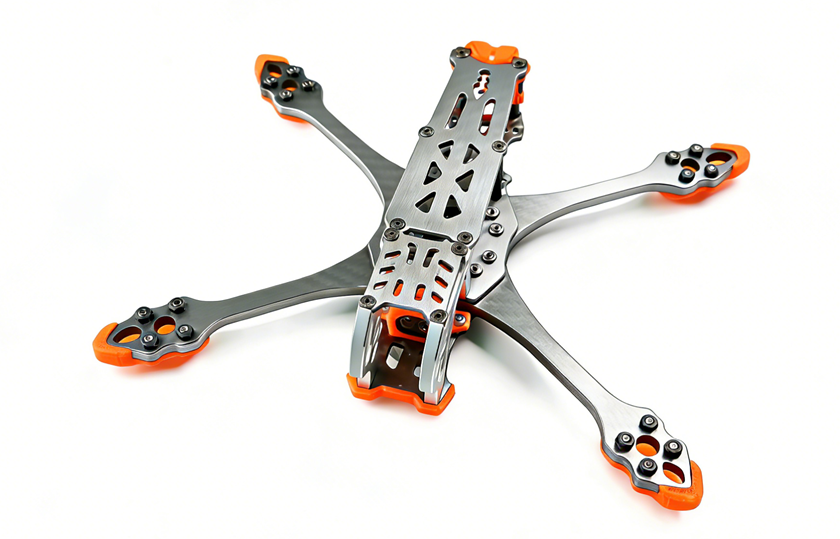
Understanding Drone Frame Sizes
1. What Do Common 3-Inch and 5-Inch Frames Actually Mean?
In practical use, drone frame sizes such as 3-inch, 5-inch, and 7-inch typically refer to the propeller diameter that the frame is primarily designed to support under standard installation conditions. For example, a 5-inch frame indicates that, with reasonable motor mounting and sufficient propeller clearance, the frame is suitable for 5-inch propellers.
It is important to note that this naming convention does not mean the frame can only use that specific propeller size, nor does it imply that any structural dimension of the frame is exactly five inches. Instead, it represents a design-level and application-level classification used to quickly identify the frame’s size range and typical use cases.
2. Relationship Between Frame Size and Wheelbase
In addition to inch-based naming, wheelbase is another frequently referenced frame parameter. Wheelbase usually refers to the diagonal distance between motor shaft centers and is an important indicator of how extended a frame’s overall layout is.
Even within the same inch category, wheelbase can vary significantly between different frames. These differences are typically influenced by arm length, arm angle, structural layout, and overall design philosophy. Some frames emphasize compactness, while others reserve more space for installation flexibility or flight stability.
Aspect | Short Wheelbase | Long Wheelbase |
Frame layout | More compact arm layout | Wider arm spread |
Propeller clearance | Tighter clearance | More propeller margin |
Flight response | Quicker rotational response | Better cruising stability |
Typical use | Tight spaces / Freestyle | Smooth cruising / Efficiency-focused |
Trade-off | Limited internal space | Larger overall footprint |
In practical use, wheelbase is mainly used to:
Compare structural compactness between frames of the same size
Assess whether sufficient safety clearance exists between propellers, motors, and arms
Evaluate available installation space for batteries, video transmitters, GPS modules, and other components
As a result, wheelbase is primarily a structural reference parameter that should be considered together with inch size, rather than used as a standalone classification standard.
3. Common Drone Frame Size Reference Chart
After understanding the basic meanings of inch size and wheelbase, the table below summarizes commonly used drone frame size ranges. This table is intended to build overall size awareness and help readers quickly compare different sizes, including their typical wheelbase ranges, motor specifications, and application scenarios.
Frame Size (inch) | Typical Wheelbase Range (mm) | Typical Propeller Size | Common Motor Size Range | Typical Use Scenarios |
2 inch | 80–100 | 2.0″ | 0802 – 1103 | Indoor flight, ultra-light FPV |
3 inch | 110–140 | 3.0″ | 1103 – 1404 | Lightweight FPV, park flying |
3.5 inch | 140–160 | 3.5″ | 1404 – 1604 | Compact freestyle, efficiency-focused setups |
4 inch | 160–180 | 4.0″ | 1407 – 1804 | Micro long-endurance, smooth flight |
5 inch | 210–230 | 5.0″ | 2205 – 2307 | Mainstream FPV, racing and freestyle |
6 inch | 240–260 | 6.0″ | 2306 – 2507 | Medium- to long-range cruising |
7 inch | 280–300 | 7.0″ | 2507 – 2806 | Long-range FPV, endurance-oriented flight |
8–10 inch and above | ≥320 | 8–10″ | 2806.5 and above (payload-dependent) | Payload carrying, industrial and engineering applications |
Notes:
The wheelbase values listed are typical reference ranges. Actual dimensions may vary depending on frame design. Motor specifications represent commonly used ranges for size-level compatibility, not specific configuration recommendations.
How Frame Size Affects Overall Drone Configuration
Drone frame size influences not only the physical dimensions of the aircraft but also flight characteristics through propeller size, motor loading, and overall weight distribution. As frame size changes, the available space for power systems and energy storage also changes, ultimately affecting responsiveness, stability, and intended use.
1. Relationship Between Propeller Size and Frame Structure
The most direct limitation imposed by frame size is the maximum safe propeller diameter. As frame size increases, wheelbase and arm length increase accordingly, providing the structural space required for larger propellers.
Smaller frames have tighter propeller spacing, which places higher demands on arm layout and installation accuracy. Larger frames offer more generous propeller clearance, reducing airflow interference between blades and improving propulsion efficiency during cruising flight.
As a result, frame size largely defines the feasible propeller range, and propeller size in turn affects thrust characteristics, efficiency bands, and operating RPM. This relationship reflects a coordinated interaction between structure and propulsion rather than a single-parameter change.
2. Matching Motor Specifications to Frame Size
Changes in frame size directly influence the practical range of motor specifications. This influence does not come from motor mounting patterns themselves, but from changes in propeller size and total system load.
Smaller frames, limited by propeller diameter, place lower torque demands on motors and emphasize lightweight design and rapid response. Larger frames, supporting larger propellers, require higher torque output and stronger sustained performance.
This is why motor specifications are typically expressed as ranges rather than fixed models in size reference charts. Frame size does not correspond to a single motor type but instead defines a reasonable and commonly accepted specification window that keeps the propulsion system and structure balanced.
3. Impact on Battery and Power System Layout
Frame size also indirectly affects battery selection and power system layout through available structural space. Smaller frames limit battery size and weight, placing constraints on endurance and auxiliary equipment. As frame size increases, allowable battery capacity and power system scale increase accordingly.
However, increased battery capacity usually comes with increased weight, which does not guarantee proportional performance gains. The structural advantage of a larger frame should be understood as offering greater layout flexibility rather than a direct promise of longer flight time or better performance.
Battery selection should therefore be evaluated in conjunction with frame size, propulsion system, and intended use case, rather than focusing solely on capacity or weight.
4. Weight, Stability, and Handling Characteristics
Ultimately, changes in frame size are reflected in overall weight distribution and flight behavior. Smaller frames, with lower mass and rotational inertia, generally provide faster attitude response and more direct control feedback, but are more limited in wind resistance and stability.
Larger frames tend to deliver smoother flight and improved cruise stability, but typically sacrifice agility and instantaneous response. These differences do not indicate performance superiority or inferiority; they are natural outcomes of differing design priorities.
Frame size itself is therefore not inherently “better” or “worse,” but represents different trade-offs between responsiveness, stability, and system scale.
Frame Size and Configuration Reference Table:
Frame Size | Typical Prop Size | Common Motor Range | Typical Battery Setup | Typical Focus |
2 inch | 2.0″ | 0802–1103 | 2S–3S (300–450 mAh) | Indoor / Ultralight |
3 inch | 3.0″ | 1103–1404 | 3S–4S (450–850 mAh) | Lightweight FPV |
4 inch | 4.0″ | 1404–1804 | 3S–4S (850–1300 mAh) | Smooth flight / Long cruise |
5 inch | 5.0″ | 2205–2307 | 4S–6S (1300–1800 mAh) | Mainstream FPV |
7 inch | 7.0″ | 2507–2806 | 4S–6S (2200–4000+ mAh) | Long-range flight |
How to Choose the Right Drone Frame Size
After understanding frame size definitions, common specifications, and their impact on configuration, selecting the right frame size becomes a process of narrowing options based on actual use requirements. There is no universal answer—selection should be guided by specific application needs.
1. Define Frame Size Based on Use Case
Frame size should primarily serve the intended application. Different sizes exhibit clear differences in agility, stability, endurance, and payload capability.
Applications that prioritize maneuverability and environmental adaptability generally favor smaller, more compact frames. Missions focused on cruising efficiency, flight stability, or payload capacity are better suited to larger frames.
For example, flight testing in urban or confined environments often emphasizes control precision and safety margins, making 2–3 inch or 3.5–4 inch frames more suitable. In contrast, open-area cruising or long-duration missions prioritize stability and efficiency, where larger frames are typically more appropriate.
2. Reverse-Selecting Frame Size from Propeller Diameter
Once usage direction is clear, a reliable approach is to start with propeller size. Since frame sizes are fundamentally defined around compatible propeller diameters, selecting the desired propeller first and then identifying the corresponding frame size range helps avoid mismatches.
This approach prevents reliance on frame names or appearance alone and maintains alignment between structure, propulsion system, and efficiency goals.
For efficiency-oriented or smooth-flight builds, users often already know they want larger propellers. In such cases, starting from the target propeller size and narrowing down frame options within the appropriate size range is more effective than trial-and-error across multiple frame sizes.
3. Balancing Weight, Endurance, and Control
Changes in frame size typically bring changes in total weight, propulsion scale, and flight characteristics, making trade-offs unavoidable.
Smaller frames excel in responsiveness and agility but are limited in endurance and stability. Larger frames deliver smoother flight and better cruising efficiency but demand more space, higher transport costs, and greater setup complexity.
In identical flight environments, smaller frames exhibit quicker attitude changes and more direct control feedback, while larger frames maintain heading and altitude more easily but respond more slowly to rapid maneuvers. These differences reflect natural size-based trade-offs rather than configuration quality.
4. Common Frame Size Selection Pitfalls
Certain common mistakes can lead to mismatches between frame size and actual needs. One is choosing a larger frame purely for “better performance” without considering operating environment, takeoff conditions, or portability. Another is overcrowding a small frame with excessive equipment, leading to cramped layouts and reduced reliability.
There have been cases where oversized frames were chosen to improve endurance, only to be limited by takeoff space and transport constraints, reducing overall usability. Conversely, undersized frames with overly dense equipment layouts often suffer from poor cooling, difficult wiring, and higher maintenance complexity.
These outcomes are not configuration errors, but consequences of mismatched size selection.
Key Purchasing Considerations After Choosing Frame Size
Once frame size is determined, the focus shifts from “which size” to selecting a frame that is structurally sound, reliable, and practical to build and maintain. Structural and design details often have a greater real-world impact than size alone.
1. Nominal Size vs. Actual Usable Space
A frame’s nominal size corresponds to its intended propeller compatibility, but this does not guarantee sufficient clearance under all conditions. Buyers should evaluate whether the frame design provides adequate space between propellers, motors, and arms—especially in compact or aggressively designed layouts.
Among frames of the same size, differences in arm length and structure can result in significant propeller clearance variations. Some frames offer minimal safety margins at full prop size, increasing the risk of reaching structural limits under high load or slight arm deformation. These differences cannot be judged by size name alone and should be verified through diagrams or user feedback.
2. Arm Structure and Motor Mount Compatibility
Even within the same size category, frames may differ in arm width, thickness, and motor mounting hole compatibility, directly affecting whether target motors can be installed without adapters.
Before purchasing, confirm that the frame supports common motor mounting patterns and that arm rigidity is sufficient for the motor and propeller combination. Narrow arms or incompatible mounting patterns can cause installation issues despite theoretically compatible sizes.
Such problems are often identifiable in advance through specifications or structural drawings.
3. Internal Layout and Electronics Installation
Frame size does not directly equate to internal usable volume. Frame height, stack area dimensions, and cable routing design all influence installation and maintenance of flight controllers, ESCs, and power modules.
When selecting a frame, ensure that it provides clear, serviceable installation zones for core electronics, not merely minimum fitment. Overly tight internal layouts increase complexity during tuning, wiring, and maintenance.
Some compact frames meet size requirements but suffer from poor internal space planning, leading to significantly higher setup and maintenance costs—issues that can often be anticipated from the structural design itself.
4. Flexibility for Future Adjustments and Upgrades
Drone configurations often evolve over time, such as changing battery specifications, adding modules, or reorganizing layouts. A frame that allows some structural and spatial flexibility better supports these adjustments.
Frames selected at their absolute structural limits leave little room for expansion, often forcing full replacement when upgrades are needed. Allowing moderate layout headroom at the purchasing stage usually reduces long-term costs and increases adaptability.
Frequently Asked Questions (FAQ)
Q1. Do different brands of 5-inch frames offer significantly different flight experiences?
Yes. Even with the same size, differences in arm rigidity, structural layout, weight distribution, and vibration control affect handling and stability. Size is only a reference; actual experience depends on design.
Q2. Does a larger frame always mean more stable flight?
Not necessarily. Larger frames often perform better in cruising and wind resistance, but stability also depends on motor matching, weight distribution, propeller efficiency, and tuning.
Q3. Can oversized or undersized power systems be intentionally used within the same frame size?
Yes, but this involves deliberate trade-offs. Larger power systems increase thrust margin at the cost of weight and consumption, while smaller systems improve efficiency but reduce headroom under load.
Q4. Does frame size affect tuning difficulty?
Yes. Smaller frames are more sensitive to parameter changes, while larger frames typically offer more tolerance but require greater attention to vibration and response characteristics.
Q5. Should beginners avoid large frames?
Not necessarily. Larger frames offer stability and endurance advantages but demand more space and higher setup complexity. Mid-size frames are often easier for beginners.
Q6. Is lighter always better for frames of the same size?
No. Excessive weight reduction may compromise rigidity and durability. Weight should be balanced with structural strength and intended use.
Q7. Is there room to compensate after choosing the wrong frame size?
To a degree. Minor mismatches can be mitigated through propeller, motor, or battery adjustments. Significant mismatches are harder to resolve.
Q8. Do industrial or mission drones follow standard inch-based sizing?
Only as a reference. Industrial designs rely more on wheelbase, payload capacity, and mission requirements.
Q9. Should a larger frame be chosen in anticipation of future upgrades?
Only if upgrades are planned. Otherwise, oversizing increases weight and operational cost unnecessarily.
Q10. Does frame size affect long-term maintenance cost?
Indirectly. Smaller frames require higher precision during maintenance, while larger frames use larger, more expensive components. Maintenance cost depends on both size and design.
Further reading:
Previous Post : Understanding 1kg Thrust Brushless Motors for Drones