
In fixed-wing drone propulsion systems, the motor does not directly generate lift but plays a critical role in flight endurance, payload capacity, and overall stability. Compared with multirotor platforms, fixed-wing aircraft prioritize continuous efficiency and long-term reliability, making motor selection highly dependent on mission requirements. Because cruise duration, payload demands, and airframe constraints vary across applications, motor KV ratings, size, and system matching must be selected accordingly. This article summarizes key motor selection principles and presents representative models for different fixed-wing flight scenarios.
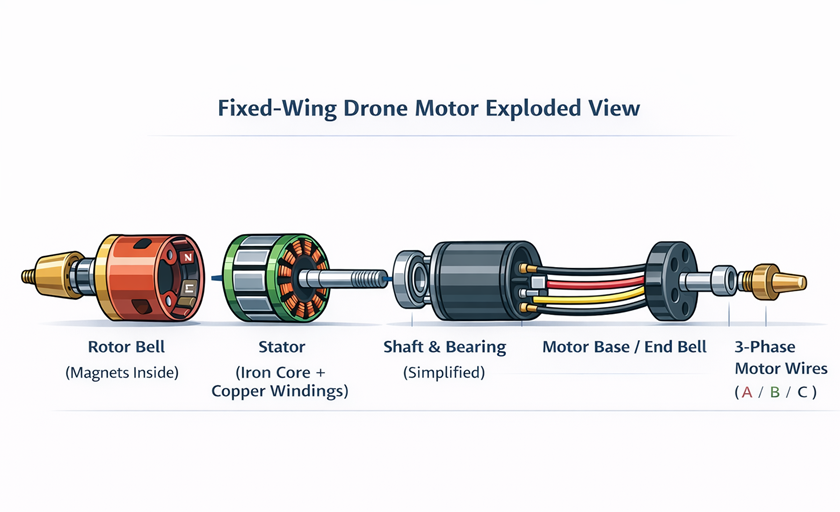
What Is a Fixed-Wing Drone Motor?
In the propulsion system of fixed-wing drone, although the motor does not directly generate lift, it exerts a decisive influence on flight endurance, payload capacity, and flight stability. Compared to multi-rotors, fixed-wing platforms place greater emphasis on continuous operating efficiency and long-term reliability, making the selection process highly scenario-dependent.
1. Introduction to Fixed-Wing Drone Motors
In a fixed-wing drone, the motor is the power source of the propulsion system. By driving the propeller to generate forward thrust, it enables the aircraft to maintain the required airspeed. The motor itself is not directly involved in lift generation; instead, it provides the stable airflow conditions necessary for the wings to produce lift. Therefore, the evaluation of a fixed-wing motor centers not on its maximum thrust, but on its efficiency performance under common operating conditions. Under the same electrical energy conditions, the ability to maintain a stable cruise with lower power consumption is the key factor affecting flight endurance and mission completion.
2. Typical Operating Modes of Fixed-Wing Motors
Fixed-wing drones have different power demands across various flight stages. The takeoff and climb phases require high power output to establish airspeed or gain altitude. Once in the cruise phase, the motor typically runs continuously under relatively stable RPM and load conditions. Since cruising accounts for the majority of flight time, the motor must maintain stable output and control temperature rise over long periods. If a motor’s efficiency is low within its common load range, even if its peak parameters are high, it may lead to higher energy consumption and thermal accumulation during long flights.
3. Core Differences Between Fixed-Wing and Multi-Rotor Motors
The differences in flight principles between fixed-wing and multi-rotor drones directly affect the motor's operating mode. Multi-rotor motors simultaneously handle lift and attitude control; their loads change frequently, requiring high response speeds and instantaneous thrust. In contrast, fixed-wing motors primarily maintain constant propulsion force during stable flight, with relatively smooth load changes.
Therefore, fixed-wing motors emphasize continuous efficiency and operational stability, while multi-rotor motors focus on thrust density and dynamic response. This difference is also reflected in propeller matching: fixed-wing aircraft often use larger-diameter, lower-RPM propellers to improve efficiency, whereas multi-rotors typically use smaller-diameter, high-RPM configurations.
Comparison Aspect | Fixed Wing Drone Motor | Multirotor Drone Motor |
Primary Function | Provides continuous, stable forward thrust to maintain airspeed for lift generation by the wing | Directly generates lift and contributes to attitude control |
Direct Lift Generation | Does not directly generate lift; lift is produced mainly by the wing | Directly generates lift |
Typical Operating State | Long-duration operation at relatively stable speed and load | Frequent speed changes with highly dynamic load conditions |
Load Variation Characteristics | Smooth and gradual load changes during cruise | Rapid and frequent load fluctuations due to maneuvering and stabilization |
Design Priority | Continuous efficiency, thermal stability, and long-term reliability | Thrust density, dynamic response, and peak power capability |
Importance of Peak Power | Lower; efficiency in the typical operating range is more critical | Higher; peak thrust directly affects maneuverability |
Typical KV Characteristics | Lower KV, suited for high-voltage, low-RPM operation | Higher KV, suited for lower-voltage, high-RPM operation |
Typical Propeller Setup | Large-diameter, low-RPM, efficiency-oriented propellers (often folding props) | Small-diameter, high-RPM, response-oriented propellers |
Motor Runtime Characteristics | Motors run continuously for most of the flight | Motors operate under constant throttle and RPM adjustments |
Thermal Stress Source | Heat accumulation from long-term continuous operation | High current spikes and short-duration high-power loads |
System Matching Sensitivity | Highly sensitive to voltage, propeller diameter, and pitch matching | More sensitive to ESC response and motor speed dynamics |
Typical Applications | Long-endurance fixed wing UAVs, heavy-payload platforms, gliders | FPV drones, aerial photography multirotors, industrial multirotors |
4. Why Do Fixed-Wing Drone Have Higher Requirements for Motors?
Although fixed-wing motors are rarely at extreme load limits, their characteristic of long-term continuous operation places higher demands on efficiency, heat dissipation, and reliability. Cruise efficiency directly affects endurance, and the heat accumulation from continuous running tests the motor's structural and material quality over long periods.
Furthermore, fixed-wing propulsion systems are particularly sensitive to matching relationships. The motor KV, voltage system, propeller size and pitch, ESC capability, and battery characteristics all collectively influence the motor's actual working state. If mismatched, a motor may operate in a low-efficiency or high-temperature range for long periods, even under a seemingly low load. Therefore, fixed-wing motor selection emphasizes overall system compatibility and long-term performance rather than the limit of a single parameter.
How to Choose Fixed-Wing Drone Motors?
Selecting a motor for a fixed-wing drone is a comprehensive judgment centered on the flight mission. Whether a motor is suitable depends on the flight purpose, airframe scale, voltage system, and propeller configuration—factors that collectively impact propulsion efficiency, reliability, and overall flight performance.
1. Define the Flight Mission and Primary Goals
Selection should start with the flight mission, not just a simple comparison of parameters. Different missions prioritize endurance, payload, takeoff performance, and structural constraints differently, leading to varying requirements for the propulsion system. Long-endurance platforms prioritize cruise efficiency; heavy-payload platforms value torque and power margins; small fixed-wings are often limited by size and weight.
Example:
If your goal is a cruise-oriented drone with maximum flight time, prioritize a motor with high efficiency at cruise throttle rather than just pursuing "excessive takeoff thrust." Conversely, if your mission involves frequent takeoffs, short runways, or high payloads, motor torque and power margins become higher priorities while maintaining efficiency.
2. Determine Propeller and Voltage Systems
In a fixed-wing propulsion system, the propeller and voltage system should generally be determined before the motor. Propeller diameter and pitch determine the required RPM and torque range, while the voltage level directly affects operating current and system efficiency. Generally, large-diameter, low-RPM propellers are more efficient but require higher voltage systems and lower KV motors.
Example:
If your airframe allows 14–16 inch propellers and you plan to use a 6S or 8S battery system, your motor selection should naturally center on the "low RPM, high torque" operating range. If you select a high KV motor first, you may be forced to use smaller propellers to adapt, eventually compromising on efficiency and endurance.
3. Select the Appropriate KV Range
KV describes the motor's RPM characteristics, not its power. For fixed-wings, the correct KV depends on whether the motor can operate within its high-efficiency RPM range during the cruise phase. Low KV is better for high voltage and large-diameter propellers; high KV is better for low voltage and smaller configurations.
Example:
If you plan to use a 10S–12S battery to drive large folding propellers for cruising, choosing a motor with a high KV will cause the motor to operate at low throttle and high voltage for long periods, which actually reduces efficiency. A more reasonable choice is a lower KV motor to ensure cruise RPM falls within the ideal range of the efficiency curve.
4. Focus on Continuous Power and Motor Size
Since fixed-wing motors run continuously, continuous power capability and thermal stability are more valuable than peak power. A motor that is too small will face heat dissipation bottlenecks; one that is too large adds unnecessary weight. A reasonable goal is to have the motor running with a certain margin during the cruise phase.
Example:
If a motor is labeled with a "Max Power of 2000W," but your aircraft needs 600–800W for cruising, it is more important to confirm if the motor has good thermal margins in that specific power range rather than its ability to burst to 2000W for a few seconds.
5. Achieve System-Level Matching
The actual performance of a fixed-wing propulsion system is determined by the overall match. The ESC’s continuous current capability and the battery’s capacity and internal resistance directly affect the motor's cruise state. Fixed-wing platforms emphasize the stability and efficiency of the entire system over the extreme parameters of a single component.
Example:
A system where the "motor power is sufficient" may still fail if the ESC operates too close to its continuous current limit or if the battery experiences significant voltage sag during cruise. These issues reflect a system-level imbalance rather than a single "wrong" component selection.
Best Motors for Long-Endurance Fixed-Wing Drones
The core goal of long-endurance platforms is to minimize unit energy consumption during long cruises. These platforms rely on low-RPM motors driving large or folding propellers, placing higher demands on efficiency, thermal stability, and mechanical reliability.
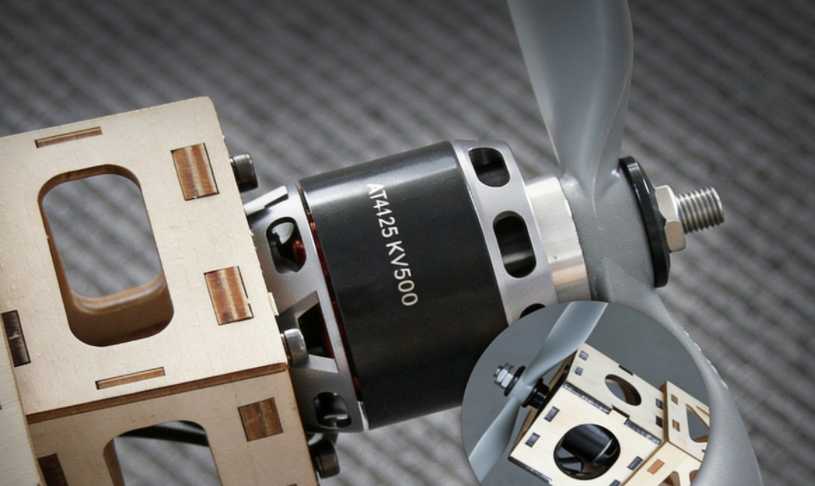
1. T-Motor AT4120 (KV250)
The T-Motor AT4120 is a medium-to-large outrunner brushless motor for fixed-wing and glider platforms. The KV250 version is primarily used for low-RPM cruise applications under high-voltage systems. Its design focuses on continuous efficiency and output stability rather than extreme power density.
Specifications:
KV: 250
Weight (incl. cable): 304 g
Motor Dimensions: Φ50 × 69 mm
Internal Resistance: 76 mΩ
Wire/Length: Enameled wire / 100 mm
Configuration: 12N14P
Shaft Diameter (Front/Rear): 6 mm
Rated Voltage (LiPo): 12S
Idle Current (10V): 1.0 A
Peak Current (180s): 45 A
Max Power (180s): 2100 W
Reason for Recommendation:
For platforms focused on endurance, cruising involves driving large propellers at low RPM. The KV250 range matches high-voltage systems easily, reducing operating current and system losses. It can operate in a stable load range for long periods, which is beneficial for temperature control and endurance performance.
2. Hacker A50-16L V4 (KV265)
The Hacker A50-16L V4 is an efficiency-oriented model in the A50 series, targeting gliders and high-efficiency fixed-wing platforms. The lower KV design is ideal for long-term continuous operation under mid-to-high voltage. It emphasizes stable output over short-term burst performance.
Specifications:
Model/Part No: A50-16 L V4 KV265
KV: 265
Max Power (Max 15 s): 1650 W
Poles: 14
Windings: 16
Idle Current I0 (8.4V): 0.95 A
Internal Resistance Ri: 0.031 Ω
Recommended Timing: 20–25°
Recommended PWM Frequency: 8 kHz
Recommended ESC Current: 70–90 A
Weight: 445 g
Outer Diameter: 48.7 mm
Length: 62.2 mm
Shaft Diameter: 6 mm
Recommended Gold Plug: 4 mm
Front Mount: Supported
Back Mount: Supported
Reason for Recommendation:
Cruise efficiency is critical for long missions. The 265KV range allows for matching with efficiency-led propeller configurations. It offers smooth output and controllable temperature rise, making it a robust choice for users seeking system reliability and consistent endurance.
Best Motors for Heavy-Payload Fixed-Wing Drones
Heavy-payload platforms require the propulsion system to maintain continuous, stable output under high loads. Selection focuses on torque capability, continuous power margins, and structural strength rather than just maximum power.
1. T-Motor AT7215 (KV200)
The T-Motor AT7215 is a large outrunner brushless motor for high-load fixed-wing platforms. The KV200 version focuses on low RPM and high torque, suitable for driving high-load propellers in high-voltage systems.
Specifications:
KV: 200
Weight (incl. cable): 550 g
Motor Dimensions: Φ81.4 × 57.9 mm
Internal Resistance: 27 mΩ
Wire/Length: Enameled wire / 100 mm
Configuration: 24N22P
Shaft Diameter (IN): 10 mm
Shaft Diameter (OUT): 10 mm
Rated Voltage (LiPo): 10–12S
Idle Current (10V): 2.4 A
Peak Current (180s): 95 A
Max Power (180s): 4400 W (12S)
Reason for Recommendation:
In heavy-payload applications, the system must provide stable and sufficient torque at low RPM. The AT7215's size and KV allow it to drive large props in high-voltage systems, lowering current pressure and providing superior thermal stability for takeoff and high-power cruising.
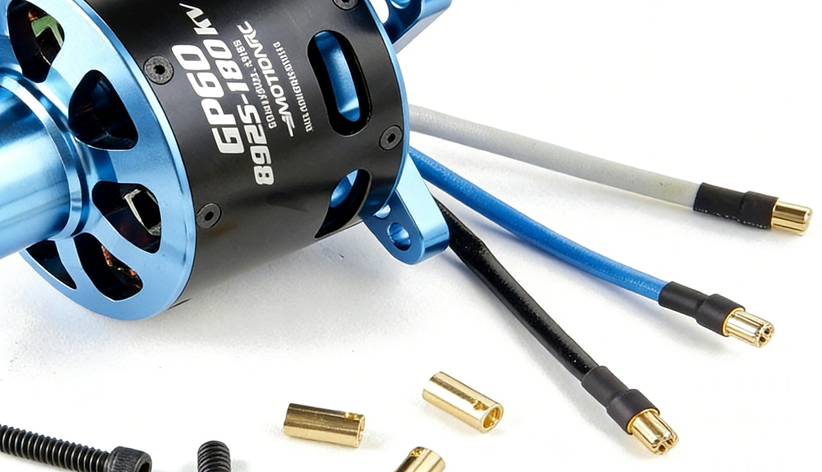
2. Admiral GP60 8925-180KV
The Admiral GP60 8925-180KV is an ultra-low KV, large-scale outrunner designed for large electric fixed-wings and gas-to-electric (IC-to-electric) conversions. It satisfies the demand for long-term stable operation under heavy-load conditions.
Specifications:
KV: 180
Max Power: 6000 W
Max Burst Current: 150 A
Recommended Battery: 12S
Recommended ESC: 160A+
Recommended Propeller: 24×10 – 25×12
Slots/Poles: 20
Shaft Diameter (A): 10 mm
Shaft Length (B): 32 mm
Motor Length (C): 66.21 mm
Motor Diameter (D): 88.5 mm
Overall Length (E): 130.5 mm
Weight: 1240 g (43.7 oz)
Connectors: 6.5 mm Bullet
Reason for Recommendation:
Large heavy-payload fixed-wings require extreme torque for large propellers. The 180KV rating allows for sufficient torque at low RPM, avoiding "forcing" the prop through excessive current. This reduces the thermal load on the system, making it suitable for long cruises with high reliability and safety margins.
Best Motors for Small Fixed-Wing Platforms
Small platforms are limited by size, weight, and propeller diameter. They emphasize power density, efficiency, and ease of matching rather than absolute power limits.
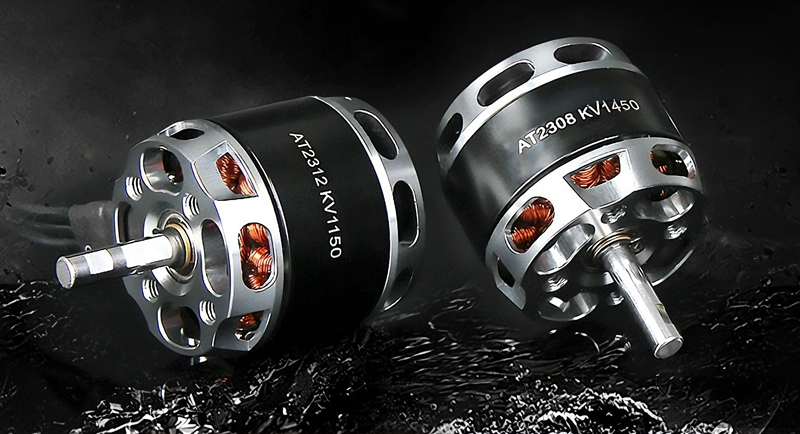
1. T-Motor AT2312 (KV1150)
The T-Motor AT2312 is a lightweight outrunner for small fixed-wings. The KV1150 version balances output and efficiency for 2S–4S systems, specifically for trainers or small platforms where volume and weight are restricted.
Specifications:
KV: 1150
Weight (incl. cable): 60 g
Motor Dimensions: Φ28.4 × 44.5 mm
Internal Resistance: 75 mΩ
Wire/Length: 22# AWG / 100 mm
Configuration: 12N14P
Shaft Diameter (IN): 4 mm
Shaft Diameter (OUT): 4 mm
Rated Voltage (LiPo): 2–4S
Idle Current (10V): 0.85 A
Peak Current (180s): 25 A
Max Power (180s): 350 W
Reason for Recommendation:
Weight and size are critical for small aircraft. The AT2312 maintains low weight while providing continuous output for routine cruising and basic maneuvers. The KV1150 range is ideal for stable operation at mid-to-low throttle, keeping energy consumption and heat under control.
2. Kavan C2822-1400
The Kavan C2822-1400 is an outrunner for light fixed-wings and trainer platforms. It prioritizes simple structure, intuitive parameters, and system compatibility over high power output.
Specifications:
Supply Voltage (LiPo): 2–3S
KV: 1400
Max Power (30s / 3S): 90 W
Max Peak Current (30s): 11 A
Idle Current (2S): 400 mA
Motor Diameter: 27.8 mm
Motor Length: 23 mm
Shaft Diameter: 3.175 mm
Weight: 34 g
Poles: 14
Recommended Timing: 15–18°
Recommended ESC: 18–20 A
Reason for Recommendation:
Stability and controllability are paramount for entry-level and training platforms. The KV matches well with 2S–3S systems for balanced takeoff and cruise. Its steady supply and low maintenance cost make it suitable for instruction or cost-sensitive projects.
Specification Summary Table for Fixed-Wing Motors:
Model | KV | LiPo Voltage | Max / Peak Current | Max Power | Weight | Motor Size (Ø × L) | Shaft Diameter | Stator / Pole Structure | Typical Application |
T-Motor AT4120 | 250 KV | 12S | 45 A (180s) | 2100 W (180s) | 304 g | Ø50 × 69 mm | 6 mm | 12N14P | Long-Endurance / High-Voltage Cruise |
Hacker A50-16L V4 | 265 KV | 6–8S (Typical) | ESC Recommended: 70–90 A | 1650 W (15s) | 445 g | Ø48.7 × 62.2 mm | 6 mm | 14 Poles | Long-Endurance / Glider |
T-Motor AT7215 | 200 KV | 8–12S | 95 A (180s) | 4400 W (12S) | 550 g | Ø81.4 × 57.9 mm | 10 mm | 24N22P | Heavy-Payload Fixed Wing |
Admiral GP60 8925 | 180 KV | 12S | 150 A (Burst) | 6000 W | 1240 g | Ø88.5 × 66.2 mm | 10 mm | 20 Poles | Large / Extreme Heavy Lift |
T-Motor AT2312 | 1150 KV | 2–4S | 25 A (180s) | 350 W (180s) | 60 g | Ø28.4 × 44.5 mm | 4 mm | 12N14P | Small Fixed Wing |
Kavan C2822-1400 | 1400 KV | 2–3S | 11 A (30s) | 90 W (30s) | 34 g | Ø27.8 × 23 mm | 3.175 mm | 14 Poles | Entry-Level / Training Aircraft |
Conclusion
Fixed-wing motor selection should be mission-centric rather than focused on a single parameter. Long-endurance, heavy-payload, and small platforms have different priorities in efficiency, torque, and weight. In practice, proper matching of KV, voltage, and propellers often impacts flight performance more than peak power. Ensuring the motor operates stably and efficiently under its primary conditions is the key to improving flight time and reliability.
Previous Post : Drone Propeller Types Explained:Key Differences