
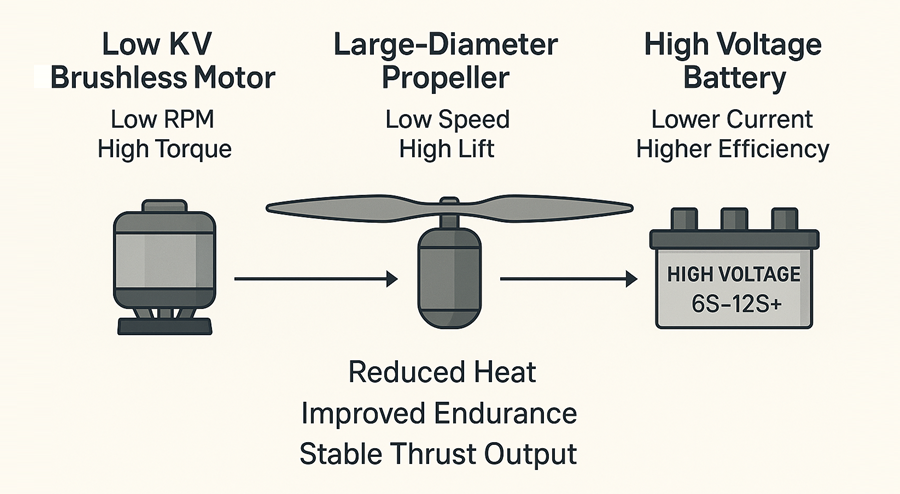
In modern drone propulsion systems, low KV brushless motors have become a key choice for industrial and commercial UAV platforms due to their efficiency and operational stability. Unlike high KV motors that emphasize high-speed response, low KV motors are better suited for applications requiring long endurance, heavy payload capability, and sustained thrust output.
As drone platforms continue to scale in size and mission complexity, propulsion system design has shifted from peak performance toward overall efficiency and reliability. With strong compatibility for large-diameter propellers and high-voltage power architectures, low KV brushless motors play an increasingly important role in inspection, mapping, agricultural, logistics, and VTOL applications.
What is a Low KV Motor for Drone?
1. What is KV Rating?
In the field of brushless motors, KV Rating refers to the theoretical no-load rotational speed of the motor per unit of voltage (Volt), typically expressed in RPM/V (Revolutions Per Minute per Volt).
For example, a motor labeled as 400 KV will rotate at approximately 400 revolutions per minute for every 1V of input voltage under ideal no-load conditions.
So-called Low KV Motors do not imply weaker performance; rather, they indicate a lower rotational speed per unit of voltage. This design orientation is not intended for high-speed rotation, but to output stronger Torque at lower speeds, thereby better driving large-sized propellers or handling higher loads.
It is important to clarify that KV is not an indicator of motor quality, nor does it directly represent power output. It is essentially a Matching Parameter used to describe the compatibility relationship between the motor, voltage, propeller size, and application scenario. Different mission requirements correspond to different KV choices.
2. Electrical Characteristics
From an electrical perspective, Low KV brushless motors typically operate in a state of lower speed and high torque. When paired with a High-Voltage Battery System, the motor can maintain a relatively low operating Current while meeting power requirements.
Lower current means reduced Resistive Loss and lower heat generation levels, which is particularly important for drones operating for extended periods. The motor, ESC (Electronic Speed Controller), and connecting cables endure less electrical stress in this operating mode, contributing to improved overall system reliability.
Under conditions of high load or long-duration hovering, Low KV motors often maintain more stable electrical performance, making power output smoother and easier for the flight control system to manage precisely.
3. Mechanical Structure & Torque Characteristics
Compared to High KV motors, Low KV motors typically employ a larger Stator Size and higher magnetic flux density to achieve stronger torque output capabilities. This structural design does not pursue instantaneous acceleration but focuses more on Sustained Thrust and long-term stable operation.
In practical applications, Low KV motors are better suited for driving large-diameter, low-speed propeller combinations. This form of propulsion can generate sufficient lift at lower rotational speeds while reducing mechanical vibration and structural fatigue, which is particularly important for aerial photography, mapping, and industrial missions.
Additionally, Low KV motors are generally designed with a greater focus on durability and heat dissipation performance to adapt to usage scenarios involving long hours of continuous work, rather than short bursts of high-load output.
4. Why Low KV Motors Work Better with High Voltage Systems
The core reason Low KV motors are often paired with high-voltage propulsion systems lies in Efficiency Improvement. Under the same power requirement, increasing the system voltage can significantly reduce the required current, thereby reducing heat generation and energy loss.
In industrial drones, common voltage platforms include 6S, 8S, 12S, and even 14S. Within these high-voltage architectures, Low KV motors can operate in a more ideal efficiency range, ensuring sufficient thrust output while effectively controlling Thermal Rise.
For this reason, many professional drone platforms adopt a "Low KV + High Voltage" propulsion architecture from the initial design phase to balance power performance, system efficiency, and long-term operational reliability. This combination has gradually become the mainstream solution for long-endurance, heavy-lift, and VTOL application scenarios.
Advantages of Low KV Motors for Drones
1. Ability to Drive Large-Diameter Propellers
One of the most significant advantages of Low KV brushless motors is their ability to stably drive Large-Diameter Propellers. In practical applications, Low KV motors are often paired with propellers ranging from 18–32 inches or even larger, without requiring the motor to work at its limit for extended periods.
Large-sized propellers can generate sufficient Lift at lower rotational speeds, which is a direct embodiment of the Low KV motor's high torque characteristic. Compared to small propeller combinations spinning at high speeds, large propellers have higher air utilization efficiency under low-speed conditions, making them especially suitable for flight missions requiring sustained thrust output.
This "Large Propeller + Low RPM" power form also provides a more reliable power foundation for drones during high loads or long-duration hovers.
2. Higher Aerodynamic Efficiency and Longer Flight Time
From an aerodynamic perspective, low-speed large propellers typically possess higher Aerodynamic Efficiency. Under the same lift requirement, they accomplish the task by moving a larger volume of air rather than creating high-speed turbulent airflow, thereby reducing ineffective energy loss.
Low KV motors are the ideal driving core for this efficient aerodynamic scheme. Since the motor does not need to maintain extremely high RPMs, the overall propulsion system consumes less energy during cruise or hover phases, helping to significantly extend the drone's Flight Endurance.
Therefore, in tasks such as power line inspection, mapping route flights, and environmental monitoring where loiter time requirements are high, Low KV motors have become almost the default choice in propulsion system design.
3. Better Thermal Stability in Long-Duration Missions
In long-duration flight missions, the thermal management capability of the propulsion system is often more critical than instantaneous thrust. When Low KV motors operate under high-voltage systems, they typically complete the required power output with lower current, which helps reduce overall Heat Generation.
Lower temperature rise is not only beneficial for the lifespan of the motor itself but also reduces the thermal burden on the ESC (Electronic Speed Controller) and battery. In scenarios involving long hovers or repetitive operations, this Thermal Stability is directly related to whether the system can run continuously and safely.
Compared to High KV motors, which are prone to rapid temperature accumulation under high loads, Low KV motors are better suited to undertake the "long-duration, stable output" work mode.
4. Smoother Operation and Higher Flight Stability
Due to the relatively lower rotational speed of Low KV motors, the Vibration and airflow pulsation during operation are generally smaller. This characteristic is particularly important in applications with high requirements for flight stability.
On drones equipped for aerial photography, mapping, or carrying precision sensors, the smoothness of the propulsion system directly affects image clarity, data accuracy, and attitude control quality. When Low KV motors run with large propellers, the thrust output is more continuous, making it easier for the flight platform to maintain a stable state.
This smoothness is not about pursuing the limits of control sensitivity, but rather a long-term optimization for Stability and Controllability geared towards professional application scenarios.
5. Essential for VTOL Lift Performance
In VTOL (Vertical Take-Off and Landing) drones, the requirements for the propulsion system during the takeoff and landing phases are distinctly different from the cruise phase. At this time, the system needs to provide continuous, stable, and predictable lift output, rather than short bursts of high speed.
The combination of Low KV motors and large-sized propellers can stably generate the required lift at lower speeds, making them very suitable as the lift propulsion unit for VTOL platforms. During takeoff and landing, this power form helps reduce attitude fluctuations and improves overall safety.
Precisely for this reason, in multi-rotor VTOL and hybrid-wing VTOL platforms, Low KV motors often undertake the most critical vertical lift tasks and are a core component of the entire platform's propulsion design.
Where Are Low KV Drone Motors Used?
Low KV brushless motors are not a generic configuration but are highly dependent on specific mission goals and platform designs. Their advantages are mainly reflected in long-duration operation, heavy payloads, stable output, and high efficiency. Therefore, they are more common in professional-grade and industrial-grade drones rather than for entertainment or racing purposes.
Application Scenario | Primary Power Requirements | Why Low KV Motors Are Suitable |
Long-Endurance Inspection Drones | High efficiency, long flight time, stable hovering | Large propellers at low RPM improve aerodynamic efficiency and reduce power consumption |
Heavy-Lift and Cargo Drones | High thrust, strong load-handling, sustained output | Higher torque output supports stable operation under heavy loads |
Industrial Mapping and Survey Drones | Flight stability, low vibration, precise attitude control | Smooth, low-speed operation improves image quality and data accuracy |
Agricultural Spraying Drones | Heavy payload, long hover time, thermal stability | High-voltage, low-current operation reduces heat buildup during continuous missions |
VTOL Platforms | Stable and predictable lift during takeoff and landing | Low RPM with large propellers provides consistent and reliable vertical lift |
Surveillance and Long-Endurance Drones | Low noise, long-duration flight, high reliability | Lower operating RPM results in reduced acoustic signature and stable long-term operation |
1. Long-Endurance Multirotor Platforms
In multi-rotor drones where endurance is the core goal, Low KV motors are almost the foundational configuration of the propulsion system. These platforms typically perform tasks such as power line patrolling, forest fire prevention, environmental monitoring, and coastal inspection, having high requirements for Loiter Time and energy efficiency performance.
Low KV motors paired with large-diameter propellers can maintain a stable hover at lower RPMs, thereby significantly reducing energy consumption per unit of time. Compared to propulsion systems pursuing high maneuverability, this configuration is better suited for long-duration cruising and fixed-point operations.
2. Heavy-Lift and Cargo Drones
In heavy-lift drones or logistics transport platforms, the propulsion system needs to sustain high thrust output for extended periods, rather than short bursts. Low KV motors, relying on their High Torque Output characteristics, can stably drive large propellers and maintain reliable thrust output under high-load states.
Whether for emergency supply delivery, industrial equipment transport, or special operation payloads, these platforms typically focus more on Power Margin and safety rather than top speed or agile handling. This is exactly the working range where Low KV motors excel.
3. Industrial Inspection and Mapping Drones
In applications such as mapping, modeling, and industrial inspection, flight stability is often more important than speed. Low KV motors run smoothly with Low Vibration levels, which helps improve aerial image quality and mapping data precision.
When a drone carries high-resolution cameras, LiDAR, or multispectral sensors, the smoothness of the propulsion system directly affects the data collection results. In these platforms, Low KV motors play the role of a "stabilizer" more than just a power source.
4. Agricultural Spraying Drones
Plant protection drones typically need to hover or fly back and forth for long periods at low altitude and low speed, while carrying heavy liquid loads. As the spraying process progresses, the total weight of the machine changes dynamically, placing higher demands on the adaptability of the propulsion system.
The efficiency advantage of Low KV motors under high-load conditions allows them to maintain stable lift during the fully loaded stage while preventing the motor and ESC from overheating due to high currents. This is one of the important reasons why current mainstream agricultural drones universally adopt Low KV propulsion architectures.
5. VTOL and Hybrid Fixed-Wing Platforms
In VTOL (Vertical Take-Off and Landing) and hybrid fixed-wing drones, the propulsion system often needs to satisfy two distinctly different operating conditions: high lift demand during the vertical takeoff/landing phase, and high efficiency requirements during the fixed-wing cruise phase.
Low KV motors are typically used for the VTOL lift units, responsible for providing sustained, controllable vertical lift. In this phase, stability and reliability are far more important than response speed, and Low KV motors satisfy this demand perfectly.
6. Special-Purpose Surveillance / Long-Endurance Drones
In special applications such as security patrols, border surveillance, and environmental observation, drones often need to operate in the air for extended periods while maintaining a low noise profile and stable flight state.
Low KV motors produce relatively lower noise (Low Acoustic Signature) when running at low speeds, while possessing good efficiency and thermal stability, making them very suitable for these mission platforms that emphasize stealth and persistence.
Low KV Motors vs High KV Motors:What Is the Difference?
There is no absolute superiority or inferiority between Low KV and High KV brushless motors; they are essentially two design orientations serving different flight goals and propulsion architectures. Understanding the core differences between the two helps avoid the misconception of "higher parameters are better" during the selection process.
Comparison Aspect | Low KV Brushless Motors | High KV Brushless Motors |
KV Rating (RPM/V) | Lower RPM per volt | Higher RPM per volt |
Typical Operating Speed | Lower rotational speed | Higher rotational speed |
Torque Characteristics | Higher torque, better for handling heavy loads | Lower torque, better for light loads |
Propeller Compatibility | Large-diameter propellers (typically 18–32 inches or larger) | Small-diameter propellers (typically 5–10 inches) |
Typical Voltage Systems | Commonly paired with high-voltage systems (6S–14S) | Commonly used with low-to-mid voltage systems (3S–6S) |
Current Demand | Lower current at equivalent power output | Higher current at equivalent power output |
Thermal Stability | Better thermal stability for long-duration operation | Faster heat buildup under sustained high load |
Operating Characteristics | Smooth, stable, continuous power delivery | Fast throttle response, high agility |
Design Focus | Efficiency, stability, sustained thrust | Speed, responsiveness, rapid acceleration |
Typical Applications | Industrial drones, mapping, inspection, agriculture, heavy-lift, VTOL, long-endurance platforms | Racing drones, freestyle, recreational and high-agility platforms |
1. RPM and Throttle Response Differences
High KV Motors have a higher theoretical rotational speed (RPM) per unit voltage, so they respond faster to throttle changes, making them suitable for flight styles requiring frequent acceleration/deceleration and rapid attitude adjustments.
In contrast, the RPM growth of Low KV motors is more gradual. The response is not aimed at being "rapid," but emphasizes Predictability and continuity of output. This characteristic is advantageous in long-duration hovering or stable cruising, helping the flight control system perform precise control.
2. Torque Output and Load Capability Differences
The core advantage of Low KV motors lies in their Higher Torque Output. When driving large-diameter propellers or carrying heavier loads, Low KV motors can maintain stable thrust at lower speeds.
High KV motors are better suited for lightweight platforms; their torque is relatively limited, but they are highly efficient under small propeller, high-speed conditions. This difference determines the clear distinction between the two types of motors regarding load capacity and applicable platform scale.
3. Propeller Compatibility Differences
In practical applications, High KV motors are typically paired with Small Propellers (around 5–10 inches) to fully utilize their high-speed advantage. Such combinations are better suited for light drones and high-maneuverability flight.
Low KV motors are commonly used with propellers ranging from 18–32 inches or even larger. Large propellers have higher aerodynamic efficiency at low speeds, which is one of the key reasons Low KV propulsion systems can achieve long endurance and high payload capacities.
4. Voltage System Compatibility Differences
High KV motors are mostly seen on 3S–6S voltage platforms, capable of achieving high RPM output at low to medium voltages. The system structure is relatively simple, suitable for entry-level or hobbyist drones.
Low KV motors are better suited for pairing with 6S–14S high-voltage systems. Under high-voltage conditions, the system can complete the same power output at lower currents, thereby improving efficiency and reducing heat generation. This propulsion architecture is particularly common in industrial-grade drones.
5. Application Scenario Differences
From an application perspective, High KV motors mainly serve scenarios such as racing, aerobatics, and recreational flying, emphasizing handling sensitivity and speed performance.
Low KV motors are more often applied in professional fields such as industrial inspection, mapping, agriculture, transport, long-endurance platforms, and VTOL. The core demands are stability, reliability, and high efficiency, rather than extreme performance.
How to Choose the Right Low KV Motors for Your Drone
Choosing a Low KV brushless motor is not simply about "the lower the KV, the better." It is a process of narrowing down options around mission goals. A logical selection process should start from the flight mission, determine key parameters of the propulsion system layer by layer, and finally form a highly matched overall solution.
1. Flight Mission and Application Requirements
Whether a low KV brushless motor is suitable for a drone platform depends primarily on the flight mission itself, rather than on any single parameter value. Different applications place different priorities on the propulsion system, and these differences define where low KV motors make sense.
For example, in power line inspection, mapping, or environmental monitoring missions, drones often operate in prolonged hover or low-speed cruise conditions with relatively stable power demand. In such cases, efficiency and thermal stability are more critical than rapid throttle response. Low KV motors are better suited to operate continuously within an efficient RPM range, helping reduce overall energy consumption and thermal stress.
2. Propeller Size and Load Conditions
In low KV propulsion systems, propeller size is often one of the most constraining factors in motor selection. As propeller diameter increases, the demand for torque rises, and the system naturally shifts toward lower rotational speeds.
On industrial multirotor platforms using 22-inch or 24-inch propellers under higher payload conditions, the propulsion system is already oriented toward low-RPM, high-torque operation. Using a higher KV motor in this context often requires limiting throttle to avoid overload, whereas a low KV motor can more naturally deliver stable and sustainable thrust.
3. KV Rating and System Voltage Matching
There is no universally “ideal” KV value independent of the system. KV must always be interpreted together with system voltage and propeller size. In low KV applications, KV primarily reflects compatibility rather than performance level.
For instance, on a 12S battery system paired with 22–24 inch propellers, the KV rating typically falls within the 300–400 range. As propeller size increases further, the appropriate KV range naturally decreases. This is not about deliberately reducing RPM, but about allowing the motor to operate within an efficient and controllable speed range during real flight conditions.
4. Motor Size and Torque Capability
Even with a well-chosen KV value, insufficient motor size can still limit real-world performance. Motor size—particularly stator dimensions—directly affects continuous torque output and thermal stability.
In high-payload or long-duration hover scenarios, motors must sustain moderate power output for extended periods. If the motor is undersized, heat accumulation becomes inevitable, eventually reducing efficiency or reliability. For this reason, low KV systems often favor motors that exceed the minimum theoretical requirement, trading slight weight increases for improved stability and service life.
5. ESC Specification and Long-Term Operation
In low KV systems, ESC selection is less about peak current ratings and more about long-term operational stability. Under high-voltage architectures, individual motor current is typically modest, but the ESC must maintain consistent performance over extended runtimes.
For example, in long-endurance inspection missions, ESCs may operate continuously under elevated ambient temperatures. If thermal design or voltage headroom is insufficient, issues can arise even when short-term operation appears normal. As a result, low KV systems place greater emphasis on sustained ESC capability rather than momentary limits.
6. Battery Voltage and System Efficiency
Low KV motors naturally pair well with high-voltage battery systems. At the same power requirement, higher voltage allows lower operating current, which reduces resistive losses and heat generation throughout the powertrain.
Under hover conditions, a 12S system experiences significantly less current stress than a comparable 6S system. This advantage becomes increasingly important during long-duration flights and explains why high-voltage architectures are widely adopted in industrial drone platforms.
7. Power Margin and Safety Envelope
The final step in low KV motor selection is evaluating overall system power margin. A well-designed propulsion system should not require motors to operate near their limits for extended periods.
For example, retaining meaningful throttle headroom during fully loaded hover indicates a healthy balance between motor, propeller, and voltage configuration. This margin improves resilience to wind disturbances, payload variation, and thermal drift, while also enhancing overall safety and long-term reliability.
Matching Low KV Motors with Props, ESCs, and Batteries
Low KV brushless motors are rarely discussed in isolation regarding their performance; their advantages are often realized within a complete Propulsion System. Only when the motor, propeller, ESC, and battery match each other can the Low KV propulsion architecture truly demonstrate its advantages in efficiency and stability.
1. Propeller Matching Principles
In a Low KV propulsion system, the Propeller is the core component that directly determines the form of thrust and aerodynamic efficiency. Generally, Low KV motors are better suited for pairing with large-diameter, relatively Low Pitch propeller combinations to fully utilize their high torque characteristics.
Improper selection of propeller diameter or pitch can lead to two problems:
Propeller too large: Causes the motor to run in a high-load zone for long periods, affecting efficiency and lifespan.
Propeller too small: Fails to effectively utilize the torque advantage of the Low KV motor, resulting in wasted energy.
Therefore, when matching propellers, the core focus should be on the thrust required for the mission and the target RPM range, rather than simply pursuing larger sizes.
2. ESC Matching Principles
The ESC (Electronic Speed Controller) undertakes the critical role of power regulation and control in Low KV systems. Its rated voltage must fully cover the operating voltage range of the battery; this is the most basic prerequisite.
In long-endurance or high-load applications, the Continuous Current Rating of the ESC is often more important than the peak current. Good thermal design and stable control algorithms help the motor maintain smooth output during long operations, avoiding protection mechanisms triggered by overheating.
In Low KV systems, choosing an ESC configuration with "slight redundancy" is usually more beneficial for system stability than matching specifications exactly.
3. Battery Matching Principles
The battery system determines the operational foundation of the entire propulsion architecture. For Low KV motors, a High-Voltage Battery Pack is often more critical than a high discharge C-rating.
High-voltage designs can significantly reduce operating current for the same power output, thereby reducing line loss and heat generation. At the same time, battery Capacity directly affects available flight time and needs to be planned reasonably based on mission duration and safety redundancy.
In practical applications, stable and continuous discharge capability is often more practically significant than nominal high C-rating parameters, especially in long cruise or hover missions.
4. System-Level Efficiency Optimization
The true value of a Low KV propulsion system is reflected in the overall improvement of System-Level Efficiency. Optimizing a single component in isolation often fails to significantly improve flight performance.
When the motor, propeller, ESC, and battery form a good match in terms of RPM range, voltage platform, and load characteristics, the system not only gains higher efficiency but also reduces vibration, noise, and thermal burden. This "holistic synergy" design philosophy is the core concept of industrial-grade drone propulsion systems.
Frequently Asked Questions (FAQ)
Q1: Do Low KV motors always save more power than High KV motors?
Not necessarily. Whether a Low KV motor saves power depends on whether it is reasonably matched with the propeller size, voltage platform, and load conditions. Under high-voltage, large-propeller configurations, Low KV motors more easily complete the required power output with lower current, thereby improving system efficiency. However, if matched improperly, overall energy consumption may actually increase.
Q2: Are Low KV motors only suitable for large or industrial-grade drones?
It does not depend solely on drone size, but mainly on mission requirements. Low KV motors are better suited for application scenarios emphasizing long endurance, heavy payloads, and stable output, which are more common in industrial and commercial drones. For lightweight or high-maneuverability platforms, Low KV motors typically struggle to fully demonstrate their advantages.
Q3: Is the performance better if the KV value is lower?
No. The KV value is merely a parameter describing the motor's speed characteristics and does not represent high or low performance or quality. An excessively low KV, if mismatched with the propeller, voltage, or load, may lead to decreased efficiency or insufficient thrust. The key lies in choosing a KV that is "suitable for the mission," not blindly pursuing a lower number.
Q4: Do Low KV motors necessarily require a high-voltage system?
Not necessarily, but high-voltage systems are generally more conducive to utilizing the advantages of Low KV motors. Under the same power demand, increasing voltage can reduce current, thereby reducing heat and energy loss. Where conditions permit, "Low KV + High Voltage" is a more common and mature industrial-grade propulsion architecture.
Q5: Will control precision deteriorate when Low KV motors run at low speeds?
Generally, no. In modern drone systems, ESC control precision and flight control algorithms have a significant impact on low-speed control. As long as the ESC, motor, and flight controller are matched reasonably, Low KV motors can achieve smooth, predictable thrust output in the low-speed range, which is even more conducive to stable control.
Q6: Are Low KV motors naturally quieter?
Under low-speed operating conditions, Low KV motors are typically more conducive to reducing noise, but noise is not determined by KV alone. Propeller design, rotational speed, aerodynamic form, and structural resonance all have a significant impact on noise levels. Low KV provides a foundational condition for low-noise operation, but system-level optimization is still required.
Q7: Will there be significant differences in actual performance between Low KV motors of the same KV but different brands?
There may be significant differences. Even if the KV value is the same, differences in stator design, magnetic circuit structure, heat dissipation capability, bearing quality, and manufacturing processes among different brands will affect the motor's efficiency, stability, and lifespan. Therefore, the KV parameter should not be the sole basis for selection.
Previous Post : A Selection Guide to 4-in-1 ESC for FPV Drones