
As multirotor UAVs evolve towards higher payloads and more complex structures, increasing the number of motors has become a common trend. When a platform expands from a quadcopter to an octocopter or an X8 architecture, the number of ESCs (Electronic Speed Controllers) rises accordingly, significantly amplifying the complexity of wiring, installation, and post-maintenance. In this context, ESC selection is no longer just about choosing a single component; it has evolved into a system-level trade-off for the entire platform. The 8-in-1 ESC was introduced to multirotor UAV systems specifically to address this need. Its emergence is not primarily to enhance flight performance, but to tackle the practical challenges of installation, wiring, and management in multi-motor platforms.
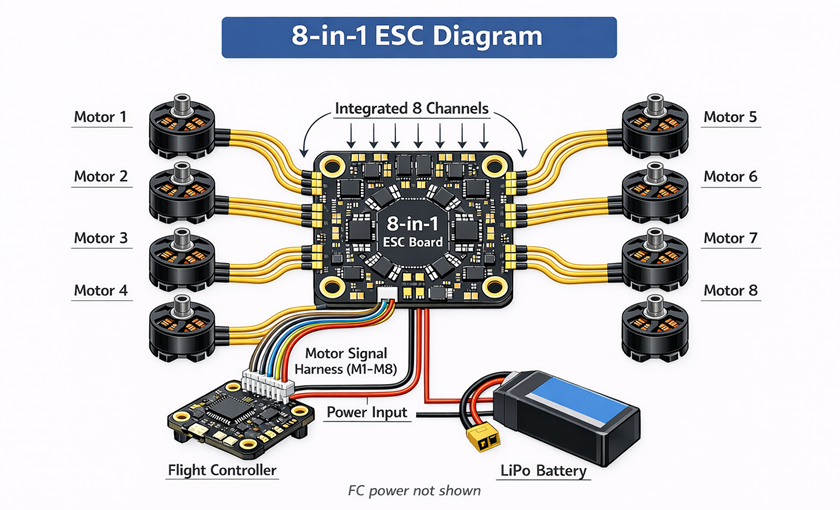
Basic Introduction to 8-in-1 ESCs
1. What is an 8-in-1 ESC?
An 8-in-1 ESC refers to the integration of eight independent brushless motor drive channels onto a single ESC module, where each channel still corresponds to and controls an independent motor. From the perspective of control logic, there is no essential difference between this and a single ESC; the motors are still driven and respond independently. The difference lies in unifying the management of multiple ESCs, which were originally installed separately, onto a single hardware platform.
In practical use, this integration mainly changes the physical form and installation method of the ESC. Compared to single ESCs that are fixed individually and wired separately, 8-in-1 ESCs emphasize centralized installation and unified connection. This makes the ESC’s presence in the drone’s structure resemble a "power management module" rather than a simple combination of multiple scattered parts.
2. Differences between 8-in-1. Single, and 4-in-1 ESCs
On UAV platforms with fewer motors, single ESCs often offer higher flexibility and are easier to replace and tune. However, when the number of motors increases to six or even eight, the wire count, mounting points, and maintenance costs associated with single ESCs are rapidly amplified.
4-in-1 ESCs alleviate this problem to some extent through integration, but in octocopter or X8 architectures, two separate ESC modules are still required, leaving the overall structure relatively dispersed. In contrast, an 8-in-1 ESC concentrates all motor drives into a single module, making power supply and signal connections more unified. In terms of user experience, it leans more towards a holistic power solution rather than a superposition of multiple ESCs.
Aspect | Single ESC | 4-in-1 ESC | 8-in-1 ESC |
Typical motor count | 1 | 4 | 8 |
Installation style | Distributed | Semi-centralized | Highly centralized |
Wiring complexity | High | Medium | Lower (centralized) |
Maintenance & replacement | Most flexible | Moderate | Usually whole-unit replacement |
Suitable platform size | Small / Medium | Medium | Medium-large / multi-motor |
Overall system neatness | Average | Good | Best |
3. Why do 8-in-1 ESCs usually appear in multi-motor platforms?
When a drone has fewer motors, the benefits of ESC integration are not obvious and may even sacrifice some flexibility. However, as the motor count increases, the installation and management of ESCs quickly become a system-level burden, where any assembly or maintenance operation is magnified into a whole project. For this reason, 8-in-1 ESCs appear almost exclusively in multi-motor, multirotor platforms, especially octocopters and X8 architectures. This is not because 8-in-1 ESCs have explicit restrictions on drone size, but because this highly integrated ESC solution only possesses real practical value when the system complexity is sufficiently high.
Which Types of UAVs are More Suitable for 8-in-1 ESCs?
The 8-in-1 ESC is not a universal configuration; its applicability is closely related to the drone's platform structure, motor count, and operational goals. In practical applications, the centralized management of ESCs only reveals significant value when the drone enters the multi-motor stage. Therefore, looking at drone types helps to clearly judge which platforms are more likely to benefit from an 8-in-1 ESC.
1. Octocopters and X8 Architecture Multirotor UAVs
In octocopter or X8 architectures, the number of motors itself dictates the complexity of ESC management. Adding a motor means adding a set of power and control links. When the count reaches eight, the wiring density and installation workload brought by single ESCs escalate rapidly. Even if 4-in-1 ESCs are used, two modules must still be distributed in different locations on the frame, making it difficult to achieve a truly unified structure.
On these platforms, the advantage of the 8-in-1 ESC lies mainly in centralized management. All motor drives are concentrated in one module, making power and signal interfaces clearer and the planning of the entire machine structure easier. This advantage does not directly improve flight performance, but it can significantly reduce the complexity of assembly and post-maintenance. Therefore, it is more easily accepted and adopted in octocopter and X8 architectures.
2. Medium-to-Large and Industrial-Grade Multirotor UAVs
As UAV applications expand from consumer aerial photography to surveying, inspection, and transport, the requirements for platform stability and reliability are constantly increasing. These medium-to-large multirotor UAVs typically feature higher payload capacities, longer mission times, and more complex system configurations. In this context, structural clarity and system consistency are often more important than the flexibility of replacing components.
In medium-to-large and industrial-grade multirotor platforms, the 8-in-1 ESC is often viewed as a more "secure" method of power management. By reducing the number of scattered components, uncertainty during the assembly process can be reduced, which also helps maintain system consistency over long-term use. This is why highly integrated ESC solutions are more commonly seen in industrial-grade multirotor UAVs.
3. Multi-Motor Platforms with Redundant Power Design
In application scenarios with high safety requirements, drones employ redundant power designs to cope with the failure of a single motor or propulsion channel. Such platforms usually require a higher number of motors to share the load, thereby improving overall reliability.
When a drone adopts a redundant design, the number and layout of ESCs become equally complex. At this point, if a large number of scattered single ESCs are used, system management and maintenance costs will rise significantly. Comparatively, the 8-in-1 ESC provides a more centralized solution, helping to maintain the controllability of the overall layout within a complex propulsion structure. Therefore, in multi-motor platforms employing redundant power designs, the 8-in-1 ESC is also more likely to be a viable option.
Scenarios Suitable and Unsuitable for Using 8-in-1 ESCs
There is no single answer as to whether one should choose an 8-in-1 ESC. It is not synonymous with being "more advanced," but is rather a solution for specific usage situations. After identifying the type of drone, it is more important to combine your own usage methods and needs to judge whether it is necessary to adopt this integrated solution.
Question | More suitable for 8-in-1 ESC | Less suitable |
Motor count | 8 motors or X8 layout | 4–6 motors |
Platform structure finalized | Yes | No |
Frequent motor/prop changes | No | Yes |
Importance of clean wiring | High | Moderate |
Accept whole-unit replacement in case of failure | Yes | No |
1. Common Situations Suitable for 8-in-1 ESCs
The value of an 8-in-1 ESC only gradually becomes apparent when the drone has a large number of motors and the ESCs have become a management burden in the overall structure. If you find during assembly that ESC placement, wire routing, and fixing methods are consuming a lot of energy or even affecting the overall layout, then a centralized ESC often brings a clearer structure and higher assembly efficiency.
Additionally, if the drone's propulsion configuration is relatively fixed and there is no need to frequently change motors or ESCs in the short term, adopting an 8-in-1 ESC makes it easier to leverage its advantages. In this case, reducing the component count and improving system consistency is often more important than the replaceability of a single part.
2. Scenarios Unsuitable for 8-in-1 ESCs
On drones with fewer motors or limited platform scale, the benefits brought by an 8-in-1 ESC are usually very limited. For users who need to frequently test, adjust, or change propulsion configurations, single ESCs or 4-in-1 ESCs still possess higher flexibility and make it easier to pinpoint and handle issues.
Furthermore, if your usage scenario places high demands on the separability of post-maintenance—wishing to quickly replace a single ESC when a problem occurs—then a highly integrated solution might actually increase maintenance costs. In these cases, continuing to use more traditional ESC solutions is often more appropriate.
3. A Simple and Practical Line of Reasoning
When making the actual choice, rather than agonizing over whether an 8-in-1 ESC is "more professional," it is better to return to a simpler question: Will it significantly simplify your usage process? If the existing ESC layout is already clear enough and maintenance is not difficult without an 8-in-1 ESC, then there is little significance in changing the solution.
Conversely, if ESCs have already become the main source of complexity in assembly and management, then the 8-in-1 ESC might be the solution prepared for this stage. Using "whether it reduces complexity and improves overall controllability" as the standard for judgment is often more valuable than simply comparing specification parameters.
Several Key Factors When Choosing an 8-in-1 ESC
Assuming it has been confirmed that an 8-in-1 ESC is needed, the problem that really needs to be solved during the selection phase is not "which one has stronger performance," but whether this highly integrated ESC solution fits the current drone platform conditions and usage methods. Unlike single or 4-in-1 ESCs, selecting an 8-in-1 ESC is more like making a system-level trade-off; once selected, subsequent integration and adjustment space will be affected.
1. Matching Voltage and Current Specifications
Voltage and current specifications are the most basic reference indicators in ESC selection, but the way these parameters are understood needs adjustment in the context of 8-in-1 ESCs. Multi-motor platforms often operate continuously under a relatively stable load state, rather than frequently hitting short-term peaks. Therefore, during selection, it is more worth focusing on the ESC's long-term load-bearing capacity when multiple motor channels are working simultaneously, rather than the limit parameters of a single path.
It is also important to note that centralized ESCs are not suitable for excessively pursuing specification redundancy (over-speccing). While specifications significantly higher than actual needs may look safer on a spec sheet, in an 8-in-1 centralized solution, redundancy often translates into increases in volume, heat generation, and system burden, rather than being naturally dispersed.
For example, when choosing an 8-in-1 ESC for an octocopter, a common situation is: the motor parameters show that the maximum current is not exaggerated, but in actual missions, eight motors need to work simultaneously for a long time. If hesitating between two ESCs—one with specifications significantly too high, leading to increased size and cost, and another with specifications closer to actual needs but with a reasonable margin—the latter is often the more rational choice. This is because in a centralized ESC solution, "sufficient and stable" has more practical significance than "higher limits."
2. The Impact of Thermal Conditions and Installation Environment
Because an 8-in-1 ESC concentrates multiple motor drives into a single module, its thermal characteristics differ significantly from dispersed ESCs. Single ESCs can rely on arm distribution and local airflow for natural cooling, whereas the heat of a centralized ESC accumulates more easily in a local area, raising the requirements for the installation environment.
Therefore, during the selection phase, simply paying attention to whether the ESC itself has a thermal design is not enough. The key is to combine this with the drone's structural layout to judge whether the installation location has sufficient ventilation conditions. If the installation space itself is restricted, even excellent thermal design will struggle to be fully effective.
In actual selection, one often encounters this situation: the drone frame structure is basically determined, and the 8-in-1 ESC can only be installed inside the center fuselage bay, rather than on the arms or an exposed location. In this case, even if the current specifications of two ESCs are similar, priority needs to be given to which one is more suitable for mounting against a base plate and has a lower dependence on airflow. Ignoring this can easily lead to thermal issues being exposed only during later continuous flights or high-load missions.
3. Control Methods and System Compatibility
From a control logic standpoint, 8-in-1 ESCs are not fundamentally different from other ESCs, but at the system level, their requirements for compatibility are more concentrated. Once a specific 8-in-1 ESC is selected, the Flight Controller (FC), signal connection methods, and power supply structure will usually be organized around it, leaving relatively limited room for later adjustments.
This means that during the selection phase, you need to confirm whether the control protocols, interface forms, and supporting documentation supported by the ESC can seamlessly interface with the existing system. Unlike decentralized ESCs, once a compatibility issue arises with a centralized ESC, it often affects the entire propulsion system rather than a single path.
In real-world selection, the FC model is often determined in advance. If choosing between two 8-in-1 ESCs, where one matches the existing FC ecosystem better in terms of signal interfaces, control protocols, or documentation support, it may be the better choice even if the other has a slight advantage in parameters. This is because once the system integration phase begins, the cost of replacing an 8-in-1 ESC due to compatibility issues is far higher than in a single ESC scenario.
4. Restrictions on Dimensions and Mounting Fit
The centralized structure of the 8-in-1 ESC places more explicit requirements on the frame layout regarding dimensions, mounting holes, and overall thickness. Unlike single ESCs that can be flexibly distributed across different positions on the arms, 8-in-1 ESCs usually need to be installed centrally with core components like the flight controller and power modules, which places higher demands on space planning.
It must also be recognized that once a highly integrated ESC is installed, the cost of later modifications and adjustments is typically high. If the drone is still in a phase of frequent trial and error or repeated structural modifications, adopting an 8-in-1 ESC too early may actually limit the flexibility of the overall design.
For example, when comparing 8-in-1 ESC models, a common situation is: parameters and price meet expectations, but upon checking the dimension drawing and mounting holes, it is found that one model conflicts significantly with the FC or power module. If the drone platform has entered the structural finalization stage, priority should be given to the solution with friendlier installation adaptability; however, if it is still in the prototype validation stage, one needs to clearly realize that once a specific 8-in-1 ESC is chosen, the freedom for subsequent layout adjustments will be significantly reduced.
Common Misconceptions About 8-in-1 ESCs
In the actual selection process, there are often some understandings surrounding 8-in-1 ESCs that seem reasonable but are not entirely accurate. These misunderstandings do not stem from technical difficulty, but rather from intuitive associations with the "highly integrated" characteristic. If not clarified, it is easy to generate unrealistic expectations during the selection phase, or even discover after use that the solution does not meet one's needs.
1. High Integration Does Not Mean "Better"
Many users, when contacting 8-in-1 ESCs for the first time, tend to equate "highly integrated" with "more advanced" or "more professional," subsequently thinking that as long as conditions permit, they should prioritize this solution. However, in practical use, the degree of integration itself is not the standard for judging the quality of a solution.
For certain drone platforms, dispersed ESCs actually offer advantages in flexibility, adjustability, and single-point maintenance. If the scale of the drone is limited, or the propulsion configuration is still undergoing repeated adjustments, a highly integrated ESC solution might actually become a limiting factor. Therefore, whether to adopt an 8-in-1 ESC should be based on platform characteristics and usage methods, rather than simply pursuing the degree of integration.
2. Using an 8-in-1 ESC Will Not Directly Improve Flight Performance
Another common misunderstanding is viewing the 8-in-1 ESC as a means of performance upgrading, expecting it to bring stronger thrust, more agile response, or more stable flight performance. But fundamentally, the integration method of the ESC does not directly change the operating characteristics of the motor and propeller.
The main value of the 8-in-1 ESC is reflected at the structural and management levels, such as simplifying wiring and improving overall consistency, rather than improving flight performance. If it is used as a core means of performance optimization, it will often lead to overly high expectations, resulting in a misjudgment of the selection result.
In terms of flight performance, what truly plays a decisive role is still the overall matching of the propulsion system, including motor specifications, propeller size, and battery configuration, rather than the integration form of the ESC.
3. Centralized ESCs Do Not Equal Better Maintenance
Intuitively, concentrating multiple ESCs into one module seems to imply that maintenance will be simpler. However, in practical use, this understanding does not entirely hold true. The advantage of a centralized ESC lies in structural unity and clean wiring, not in the efficiency of handling single-point failures.
Once an 8-in-1 ESC shows an abnormality, it often requires troubleshooting the entire module or even a complete replacement, rather than being able to quickly replace just one channel like a single ESC. This maintenance method is more suitable for planned maintenance and overall replacement, and is not suitable for scenarios requiring frequent on-site adjustments or rapid troubleshooting. Therefore, during the selection phase, if there is a clear preference for maintenance methods—such as preferring local replacement or rapid on-site processing—then a highly integrated ESC solution may not be the optimal solution.
4. Upgrading to an 8-in-1 ESC Later Is Not Necessarily Easier
There is also a common thought to use dispersed ESCs first, and then upgrade to an 8-in-1 ESC after the platform matures. On the surface, this is a lower-risk choice, but in actual operation, this "late-stage upgrade" is not always smooth.
Because 8-in-1 ESCs differ significantly from dispersed solutions in terms of dimensions, mounting holes, and installation methods, changing them later often involves adjustments to frame layout, power routing, and even the overall structure. If corresponding space is not reserved during the early design stage, the cost of a later upgrade may be far higher than adopting a centralized solution from the start. Therefore, whether to use an 8-in-1 ESC is often better judged once and for all during the phase when the platform structure is being determined, rather than treating it as an option that can be switched at any time.
Recommended Mainstream 8-in-1 ESC Models in the Market
After deciding to adopt an 8-in-1 ESC, the number of mature models actually available is not large. Compared to 4-in-1 or single ESCs, 8-in-1 ESCs are more oriented towards specific platform usage, and their positioning and usage boundaries are more distinct. The following three products correspond to stable X8 platforms, general solutions with larger specification margins, and performance-oriented X8 architecture solutions, covering the most common selection needs among current multi-motor drones.
型号 | 输入电压 | 持续电流 | 峰值电流 | 固件 | MCU | 电流传感 / 遥测 | BEC | 安装孔距 | 重量 | 定位倾向 |
3–8S | 8 × 55A | 8 × 65A | BLHeli_32 | — | 支持 | 无 | 30.5 × 30.5 mm | 64 g | 稳定 / 工业取向 | |
Aikon AKC70 | 3–8S | 8 × 70A | 8 × 80A | BLHeli_32 | STM32G071 | 支持 | 无 | 30.5 × 30.5 mm | 68 g | 高余量 / 通用 |
iFlight Thunder 80A | 2–8S | 80A × 8(单路) | 100A | BLHeli_32 | STM32G071 | 支持 | 无 | 30.5 × 30.5 mm | 61 g | 高性能 / X8 |
1. Stable X8 Platform Solution —T-HOBBY Cine 55A 8-in-1 ESC
The T-HOBBY Cine 55A is an 8-in-1 ESC with very clear positioning. It is not designed for extreme power or short-term bursts, but rather for X8/Octocopter platforms where stability is the core appeal, emphasizing consistency and reliability during long-term operation. This orientation is consistent with T-HOBBY's consistent product style leaning towards professional and engineering applications.
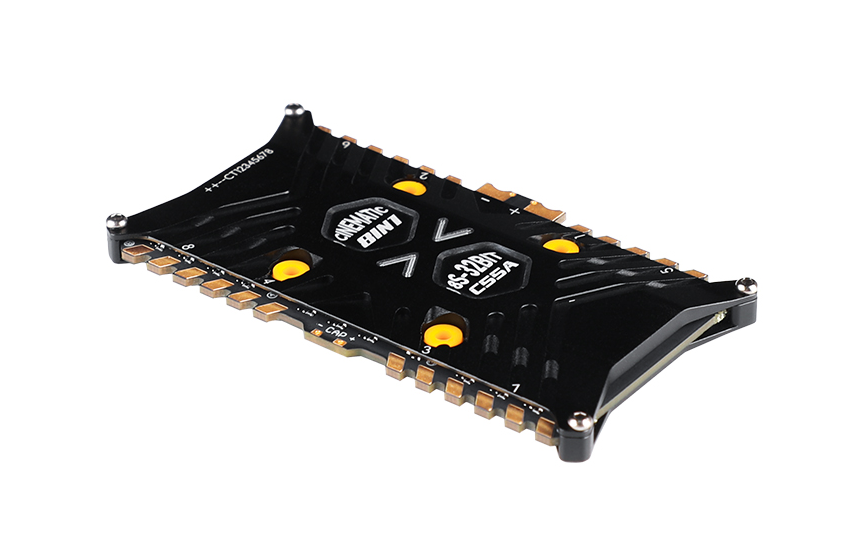
Specifications
Input Voltage: 3S–8S
Continuous Current (ESC): 8 × 55A
Peak Current (ESC): 8 × 65A (3 seconds)
ESC Firmware: BLHeli 32bit
Mounting Pattern: 30.5 × 30.5 mm / M3
Dimensions: 95.2 × 53 × 8.2 mm
Weight: 64 g (excluding wires)
Applicable Scenarios
This ESC is more suitable for multi-motor platforms with clear payload goals and primarily stable missions, such as X8 architecture drones used for surveying, inspection, cinelifters, or medium-payload aerial photography. In these scenarios, the propulsion system typically does not need to frequently hit limits, but places more value on whether the overall system is stable and easy to integrate.
Adaptation Reminder
The Cine 55A is more like a "safe choice." If your platform might significantly increase payload later, or plans to switch to a higher power motor configuration, you need to confirm in advance during selection whether its current margin and thermal layout can still meet the needs.
2. General Solution with Higher Redundancy — Aikon AKC70 8-in-1 ESC
The Aikon AKC70 is an 8-in-1 ESC that reserves more room at the specification level. Compared to the conservative stable solution, it emphasizes margins in current and voltage, and is often used for those multi-motor platforms that "can fly now, but might be heavier in the future."
Specifications
Input Voltage: 3S–8S
Continuous Current (ESC): 8 × 70A
Peak Current (ESC): 8 × 80A
Amp Meter Scale: 150
ESC Firmware: BLHeli_32
ESC MCU: STM32G071K8U6
Firmware Target: Blheli32_AIKON_G02
Current Sensor: Supported
Telemetry: Supported
Mounting Pattern: 30.5 × 30.5 mm
Dimensions: 87.5 × 56.5 × 9.2 mm
Weight: 68 g
Applicable Scenarios
The AKC70 is more suitable for platforms that have certain expectations for future expansion, such as octocopter/X8 drones that might change to larger propellers, increase power output, or adjust mission payloads. In these cases, leaving a margin in ESC specifications can often reduce the risk of needing a total replacement later due to insufficient power.
Adaptation Reminder
Higher current specifications usually mean more concentrated heat output. When choosing the AKC70. you need to simultaneously consider frame space, internal airflow, and power wire quality. If thermal and power supply conditions are insufficient, its specification advantages may not be fully realized in actual use.
3. Performance-Oriented X8 Platform Solution — iFlight Thunder 80A 8-in-1 ESC
The iFlight Thunder 80A is an 8-in-1 ESC with a distinctly performance-oriented bias. Its design focus lies in power density and dynamic response capabilities, rather than industrial-grade redundancy or long-duration heavy-load operation. This is consistent with iFlight's brand positioning in the field of high-performance electronics.
Specifications
Input Voltage: 2S–8S
Continuous Current (ESC): 80A (per channel)
Peak Current (ESC): 100A
ESC MCU: G071
BEC: None
ESC Firmware: BLHeli_32 32.9
Current Sensor: Supported
Current Rate: 250
Telemetry: Supported
Firmware Target: IFLIGHT_BLITZ_G2
Mounting Pattern: 30.5 × 30.5 mm (Φ4)
Dimensions: 100 × 60.5 mm (±1)
Weight: 61 g (±1)
Supported Protocols: DShot150/300/600. MultiShot, OneShot, etc.
Applicable Scenarios
This ESC is more suitable for X8 architecture drones that have explicit requirements for power output and response capabilities, such as platforms leaning towards high power density and performance orientation. Its advantage lies in a high specification ceiling and complete functional configuration, making it suitable for users who hope to achieve stronger power and more detailed monitoring on a centralized ESC.
Adaptation Reminder
The Thunder 80A is not equivalent to an industrial-grade heavy-lift ESC. Since the official specs note it has no BEC and the power class is high, you need to plan the power supply scheme in advance during selection and ensure that the frame structure and thermal conditions can support high-power centralized operation.
Frequently Asked Questions (FAQ)
Q1. After using an 8-in-1 ESC, can individual motors still be debugged or calibrated independently?
Yes. An 8-in-1 ESC simply concentrates the hardware onto one board; each motor is still an independent channel in terms of control logic. Motor direction, response, and calibration are still completed separately via the flight controller and configuration software, without interfering with each other.
Q2. If one channel of the 8-in-1 ESC is damaged, must the whole unit be replaced?
In most cases, yes. Due to the highly integrated hardware, a single channel failure usually cannot be replaced individually like a single ESC. This is a realistic trade-off that needs to be explicitly accepted before using an 8-in-1 ESC.
Q3. Are 8-in-1 ESCs more prone to systemic failure or instability?
No. Stability depends more on power supply quality, wiring standards, and thermal conditions rather than the form of integration itself. As long as the system design is reasonable, the stability of an 8-in-1 ESC is not fundamentally different from dispersed solutions.
Q4. Can I mix 8-in-1 ESCs and single ESCs on the same drone platform?
From a technical perspective, it is feasible, but it is not recommended in actual projects. Mixing them increases wiring complexity and system inconsistency, and is detrimental to later maintenance. It usually only appears in temporary testing or transitional solutions.
Q5. Does using an 8-in-1 ESC place higher demands on the flight controller?
It does not place significantly higher demands on the flight controller's performance itself, but it is more specific regarding interface planning and system matching. Since motor signals are input centrally, the flight controller needs to possess stable multi-channel outputs and clear interface definitions.
Q6. Will an 8-in-1 ESC limit the space for later propulsion upgrades?
To a certain extent, yes. 8-in-1 ESCs are more suitable for platforms where the propulsion scheme is basically determined. Once selected, its voltage level, current capability, and installation method will form constraints on subsequent upgrades.
Q7. Is an 8-in-1 ESC suitable for individual hobbyists or DIY projects?
Suitability depends on the project stage, not the identity of the user. If the project structure is stable and you wish to simplify wiring and improve overall tidiness, an 8-in-1 ESC is equally suitable for individual hobbyists; if the configuration is still being frequently altered, it is less suitable.
Q8. Does using an 8-in-1 ESC really save space?
It is usually tidier in terms of overall structure, but not necessarily smaller in single-point volume. It reduces occupation on the arms and peripheral wiring, but the body size is more concentrated. Whether it "saves space" depends on the frame layout method.
Recommended Reading:
Previous Post : How to Choose a 1404 brushless Motor for FPV Builds