
In a drone's propulsion system, the propeller plays the core role of converting rotational power into thrust. Its design directly impacts flight efficiency, noise levels, and handling performance. As drone application scenarios become increasingly specialized, propellers are no longer "one-size-fits-all" universal components. The differences in blade count, material selection, and structural form all correspond to specific performance orientations and usage logic. Starting from basic parameters, this article systematically outlines the primary types of drone propellers and their performance differences, combined with practical application scenarios to help readers establish a clear and actionable selection mindset.
Common Parameters of Drone Propellers
The structure of a propeller is not complex, but subtle differences in dimensions and parameters are often significantly magnified during actual flight. Therefore, before discussing propeller types, it is necessary to understand their most basic structural components and the meaning of their parameters.
Parameter | Definition | Direct Impact on Flight | Typical Tendency |
Diameter | Maximum air disc covered during rotation | Determines thrust and efficiency at a given RPM | Larger diameter: lower RPM, higher efficiency |
Pitch | Theoretical forward distance per revolution | Affects speed potential and load characteristics | Higher pitch: higher speed / heavier load |
Blade Count | Number of blades generating thrust simultaneously | Influences thrust continuity and response speed | More blades: faster response |
Material | Material used for blade construction | Affects stiffness, deformation, and thrust consistency | Higher stiffness: better stability under load |
1. Basic Components of a Propeller
A drone propeller primarily consists of blades and a hub. The blades are the parts in direct contact with the air; their shape and size determine how the air is moved. Blades are not flat; they feature an airfoil profile that generates thrust through rotation. The hub is located at the center and is used to connect to the motor output shaft and transmit rotational power. While the hub itself does not participate in aerodynamic action, it is crucial for stability and safety. The mounting interface between the propeller and the motor primarily concerns compatibility and fixation methods.
2. Propeller Diameter
Propeller diameter refers to the maximum dimension of the circle formed during rotation, which determines the volume of air the propeller can act upon at once. A larger diameter covers more air and typically generates sufficient thrust at lower RPMs (revolutions per minute), resulting in smoother flight performance. Smaller diameter propellers rely on higher RPMs to work, offering faster response speeds, making them more suitable for flight styles requiring agile handling. The choice of diameter is closely related to the drone type and usage scenario.
3. Propeller Pitch
Pitch represents the theoretical distance a propeller would move forward in one full revolution under ideal conditions. It is a parameter used to describe the "strength" with which the blades push the air. Propellers with a higher pitch are biased toward high-speed flight performance but place higher demands on the propulsion system; propellers with a lower pitch make it easier to maintain smoothness and controllability during low-speed flight and hovering. Pitch does not represent the actual flight distance but serves as a relative comparison between different propellers.
4. Labeling Conventions
Propellers are usually marked using the "Diameter × Pitch" format. For example, "10×4.5" indicates a diameter of 10 inches and a pitch of 4.5 inches. Currently, mainstream products mostly use Imperial units. Understanding these numbers helps in quickly judging the general characteristics of a propeller, though actual performance is still influenced by factors such as material and shape.
What types of drone propellers are there?
In drone applications, "types" of propellers are not complex concepts created artificially. Instead, they are design differences that have naturally formed through long-term flight practice to adapt to different sizes, payloads, and mission requirements. The significance of understanding these types lies not in memorizing the names themselves, but in understanding which drone and flight scenario each is best suited for.
From a usage perspective, drone propellers can generally be distinguished across three dimensions: blade count, material type, and structural form. These three classification methods complement each other and collectively determine the overall characteristics of a propeller.
1. Blade Count
Changes in the number of blades directly affect the frequency and manner in which air is moved, thereby altering the characteristics of thrust output. This difference is very pronounced across different flight missions.
Blade Count | Thrust Characteristics | Efficiency | Current Draw | Typical Applications |
Single-blade | Minimal theoretical airflow interference | High (theoretical) / Low (practical) | Unstable | Research / experimental use |
Two-blade | Smooth and balanced thrust | ★★★★★ | Low | Aerial photography / industrial / general-purpose |
Three-blade | More concentrated thrust | ★★★☆☆ | Medium–High | FPV / racing / freestyle |
Four or more | Highly continuous thrust output | ★★☆☆☆ | High | Special stability-oriented applications |
1.1 Single-Blade Propellers
Theoretically, single-blade propellers have high efficiency potential because only one blade is working, minimizing aerodynamic interference. However, in practical applications, this structure must use a counterweight to maintain rotational balance, which increases structural complexity and negates the original efficiency advantage. Additionally, they require high manufacturing precision and consistency and lack an advantage in reliability. Consequently, they have almost no practical application in civilian, consumer, or industrial drones and are mostly used for experimental validation or research.
1.2 Two-Blade Propellers
These are currently the most widely used and versatile form. They provide a balanced solution between thrust output, efficiency, and stability, capable of meeting diverse needs from small aerial photography drones to medium-sized industrial platforms. For missions emphasizing stable hovering, smooth flight, and energy efficiency, two-blade propellers are usually the safest and most common choice, making them the default configuration for most multi-rotors.
1.3 Three-Blade Propellers
By increasing the blade count, air is pushed more continuously and densely. Given the same diameter, this design often provides more concentrated thrust and exhibits a more direct response during rapid acceleration/deceleration and attitude adjustments. Therefore, three-blade propellers are common in FPV racing drones and platforms requiring high handling consistency. Accordingly, due to increased aerodynamic interference, their efficiency is typically lower than two-blade designs, and current consumption is higher.
1.4 Four-Blade and Multi-Blade Propellers
As the blade count increases further, multi-blade propellers emphasize the smoothness and stability of thrust output. These propellers can reduce thrust pulsation at low speeds or specific operating conditions, making flight performance steadier. However, this comes with increased weight, decreased efficiency, and changes in noise profile. Thus, multi-blade propellers are typically used only for specific needs rather than as a general-purpose solution.
2. Blade Materials
The material used directly affects the deformation characteristics of the blades during rotation, thereby influencing thrust consistency and flight stability. Compared to blade count, material types often have a more distinct correspondence with usage scenarios.
Material Type | Stiffness | High-RPM Deformation Control | Cost | Typical Platforms |
Plastic / Nylon | Low–Medium | Moderate | Low | Entry-level / lightweight drones |
Carbon Fiber | High | Excellent | High | Industrial / heavy-lift drones |
Composite Materials | Medium–High | Good | Medium | Mid-to-high-end aerial photography |
2.1 Plastic / Nylon Propellers
These are the most common in consumer-grade drones, widely applied in entry-level aerial photography drones, light multi-rotors, and daily flight platforms. They are lightweight, low-cost, and possess a certain degree of flexibility, meaning they don't break immediately upon minor collisions or ground contact. This makes them suitable for high-frequency use and practice. However, at high RPMs or larger sizes, material deformation may affect efficiency and consistency, making them unsuitable for high-payload or large platforms.
2.2 Carbon Fiber Propellers
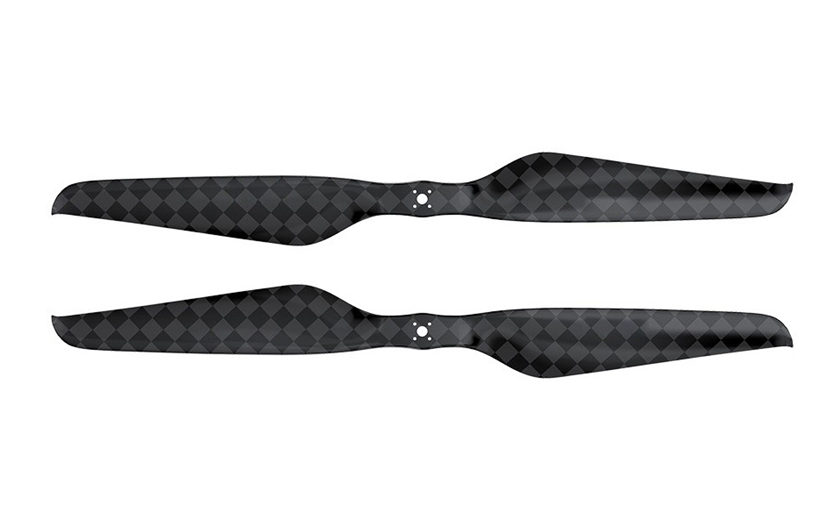
These are typically used for large-scale and industrial-grade drones, such as agricultural spraying drones (plant protection), mapping drones, inspection, and logistics drones. These drones often use larger diameter propellers and operate under high power for long durations. Carbon fiber offers higher rigidity (stiffness) and is less prone to deformation under high-speed rotation and heavy loads, maintaining stable thrust and flight attitude. This gives them an advantage in industrial applications, though they are more expensive and require stricter installation precision and maintenance.
2.3 Composite and Reinforced Propellers
These achieve a balance between rigidity, toughness, and cost by combining multiple materials. They are common in mid-to-high-end consumer drones and some professional platforms that seek good flight consistency while balancing durability and cost control. In aerial photography and industry applications, these are often a compromise yet practical choice.
3. Propeller Structure
Beyond blade count and material, the structural form also affects the applicable platform and environment.
Structural Type | Design Characteristics | Primary Advantage | Key Trade-off | Typical Applications |
Fixed Propeller | Blade angle and position are permanently fixed | Simple structure, high reliability, consistent performance | No folding capability, requires more space | Multirotor drones, aerial photography, industrial UAVs |
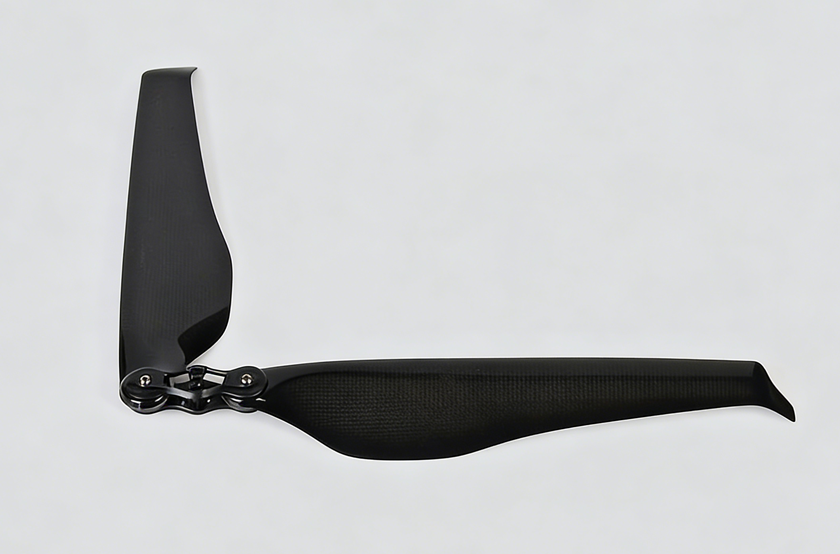
Folding Propeller | Blades fold back when stopped and deploy via centrifugal force during rotation | Compact storage, improved aerodynamics in forward flight | More complex structure, hinge wear over time | Fixed-wing UAVs, VTOL aircraft |
3.1 Fixed-Pitch Propellers
Once installed, the blade angle remains constant. The structure is simple and reliable. This design offers consistent flight performance and low maintenance costs, making it the most common in multi-rotor drones for the vast majority of aerial photography, industrial, and consumer applications.
3.2 Folding Propellers
Through a hinge structure, the blades can fold backward when rotation stops and unfold via centrifugal force during flight. This design is mostly used in fixed-wing or VTOL (Vertical Take-Off and Landing) drones, primarily to meet storage, transport, or aerodynamic layout requirements rather than to enhance flight performance. On specific platforms, they offer irreplaceable structural advantages.
Impact of Different Propeller Types on Drone Performance
The previous chapter categorized propellers by structure, material, and form. However, in practice, the category itself is not the end goal; what matters more are the specific changes in flight performance after swapping propellers. This chapter translates these design differences into more intuitive performance and handling experiences.
It should be noted that performance differences between propellers are rarely a change in a single metric; multiple characteristics usually change simultaneously. Thrust, efficiency, noise, and flight control feel are typically affected together, which is why there is no "best" propeller for every scenario.
1. Influence on Thrust Generation
The biggest difference in thrust generation between propellers is whether they "move a large volume of air slowly" or "move a small volume of air quickly." Larger diameter propellers with fewer blades tend to act on a larger volume of air at lower RPMs, producing smoother thrust suitable for long-duration hovering or constant-speed flight. Conversely, smaller diameter or multi-blade propellers usually rely on higher RPMs; their characteristic is rapid thrust variation, making it easier to achieve quick acceleration and attitude adjustments.
In actual flight, this difference is directly reflected in the takeoff style and power overhead. For instance, platforms focused on stability and payload usually have a gentler takeoff, while maneuverability-focused drones exhibit more direct and "crisp" power feedback.
2. Trends in Efficiency and Current Consumption
Propeller efficiency is reflected in how much energy is consumed to maintain flight in a given state. Generally, propellers with fewer blades and less aerodynamic interference maintain higher efficiency during hover and cruise. This is why aerial photography and industrial drones prioritize two-blade, large-diameter propellers.
When blade count increases or material rigidity improves, thrust output becomes more direct, but air turbulence and load increase as well. These propellers have an advantage in rapidly changing conditions, but under identical thrust requirements, they usually lead to higher current consumption. Therefore, for missions emphasizing endurance (flight time), this design is not necessarily the optimal solution.
3. Noise Characteristics and Acoustic Performance
Noise is not solely dependent on RPM; it is closely related to blade count, material, and aerodynamic shape. The more blades there are, the higher the frequency at which the air is "cut," resulting in a denser sound that is more easily perceived by the human ear. In contrast, propellers with fewer blades and lower RPMs produce sounds that are typically deeper and more continuous.
Material also affects noise. High-rigidity propellers deform less, providing direct thrust but also transmitting vibrations more easily. Flexible materials might dampen high-frequency noise to an extent but may introduce additional aerodynamic losses. Consequently, in noise-sensitive applications, propeller selection often involves a trade-off between efficiency and acoustic performance.
4. Impact on Flight Control Response and Handling Feel
Propellers affect not just the magnitude of thrust but also how the drone reacts to control commands. Propellers with more blades or higher rigidity tend to reflect RPM changes in thrust output more quickly, making the drone's pitch, roll, and yaw operations feel more direct. This is particularly noticeable in missions requiring frequent attitude adjustments.
Relatively speaking, propellers emphasizing efficiency and stability offer smoother thrust transitions, making the handover between flight control commands and actual movement feel softer. This is an advantage for aerial photography and cruising but may feel "sluggish" in scenarios pursuing extreme agility.
How to Choose the Right Type of Drone Propeller?
After understanding structural characteristics, type differences, and performance impacts, the key to selection is not finding the "most powerful" solution, but finding the best match for a specific drone platform. This chapter breaks the selection process into clear judgment steps.
Flight Scenario | Common Blade Count | Typical Material | Performance Priority |
Aerial Photography / Cruise | Two-blade | Plastic / Composite | Efficiency & smoothness |
FPV / Freestyle | Three-blade (most common) | Plastic / Carbon fiber | Responsiveness |
Mapping / Inspection | Two-blade | Carbon fiber | Stability & endurance |
Agriculture / Heavy-lift | Two-blade | Carbon fiber / reinforced composite | High load capability |
1. Start with Drone Type and Size
The first consideration is the drone's type and size. Arm length, wheelbase, and total weight determine the allowable diameter range and whether complex structures are suitable. Regardless of performance goals, the propeller must match the platform's size and structure; this is the prerequisite for all selection.
Example: For a small-to-medium multi-rotor used for urban aerial photography with a limited wheelbase, portability and stability are key. Choosing a standard-sized, fixed two-blade propeller usually yields smooth, predictable performance. Attempting larger diameters or multi-blade props might result in limited installation space or strained power during takeoff, degrading the overall experience.
2. Judge Load Capacity Based on Motor and Power Platform
After confirming the size range, the next step is determining if the propulsion system can stably drive that type of propeller. Different blade counts and materials create significantly different loads on the motor and ESC (Electronic Speed Controller). If the load is too high, the system will "remind" you of the mismatch through heat or efficiency drops.
Example: A drone using medium-power motors for endurance might fly normally with two-blade plastic props. Swapping to same-sized three-blade carbon fiber props might feel more powerful initially, but continuous flight will reveal significantly shortened endurance and higher motor temperatures. This indicates the system is better suited for the lighter, efficiency-oriented configuration.
3. Determine Performance Priority Based on Flight Mission
Different missions prioritize different performance aspects. Whether you value long-term stable flight or rapid response and maneuverability directly dictates the propeller choice.
Example: A mapping drone needs to fly at a fixed altitude and speed with stable imagery. Here, efficiency and smoothness are far more important than instantaneous acceleration, making a two-blade, large-diameter, efficiency-oriented prop the better choice. Conversely, the same-sized drone used for close-range dynamic filming or FPV flight might favor three-blade propellers for more consistent handling feedback.
4. Choose Material and Structure Based on Environment
The material and structure should match the actual operating environment. Flight frequency, operation duration, and reliability requirements all influence material choice. "Premium" materials aren't always better; they must suit long-term usage conditions.
Example: An agricultural spraying drone operates outdoors for long hours with large diameter props. If the blades deform at high RPMs, efficiency and stability suffer. Thus, carbon fiber or reinforced composites are better to ensure shape stability under high load. Meanwhile, small drones for daily practice or leisure are better off with low-cost, crash-resistant plastic or nylon propellers.
5. Validate and Fine-Tune Through Actual Flight
Even if the logic holds up in theory, the ultimate test is actual flight. Environmental conditions, installation precision, and individual hardware variances can cause performance to deviate from expectations.
Example: Test two propellers of similar diameter but different materials on the same drone. Record flight time, motor temperature, and handling feel. Through a few comparative flights, it usually becomes clear which configuration better meets your needs for endurance, stability, or response.
Frequently Asked Questions (FAQ)
Q1: Does increasing the number of propeller blades always result in higher thrust?
Not necessarily. Adding more blades mainly changes how thrust is delivered—making it more continuous—rather than simply increasing maximum thrust. Under the same diameter and power conditions, multi-blade propellers often introduce higher aerodynamic load and are not always more efficient.
Q2: Why are single-blade propellers rarely used on multirotor drones?
Single-blade propellers require counterweights to maintain rotational balance, which increases structural complexity and uncertainty. Multirotor platforms prioritize consistency and reliability, making single-blade designs impractical for real-world applications.
Q3: Are tri-blade propellers always more responsive than bi-blade propellers?
Not necessarily. Tri-blade propellers often provide smoother and more continuous thrust response, but actual control responsiveness also depends on motor acceleration capability and flight controller tuning. Without proper system matching, the advantage may be minimal.
Q4: Do plastic propellers noticeably affect flight stability?
Under light loads and low to medium RPM, deformation is usually within acceptable limits. However, in high-load or large-diameter applications, material flexibility may reduce thrust consistency and affect stability.
Q5: Are carbon fiber propellers suitable for all high-performance drones?
No. Carbon fiber propellers are better suited for high-load, long-duration operating conditions. In lightweight or short-duration, highly dynamic flights, their stiffness advantages may not be fully realized.
Q6: Do folding propellers affect flight stability?
When properly designed and installed, their impact on flight stability is generally limited. However, due to the presence of moving joints, long-term consistency and durability depend more heavily on manufacturing quality and maintenance.
Q7: Why do most multirotor drones use fixed propellers?
Fixed propellers have a simple structure and stable geometry, making them well suited for frequent start-stop cycles and rapid RPM changes. They also allow flight control systems to predict thrust output more reliably.
Q8: Is there a noticeable aerodynamic difference between fixed and folding propellers?
Even with identical size and material, structural differences can affect stability and consistency at high rotational speeds. Fixed propellers generally offer more predictable aerodynamic performance.
Recommended Reading:
Best Large Drone Propellers for Agri,Industrial & Heavy-Lift
Previous Post : How to Choose an 8-in-1 ESC for Multirotor UAVs