
In the propulsion systems of multirotors and FPV drones, the Electronic Speed Controller (ESC) undertakes the core tasks of driving and regulating the motor. The firmware of the ESC determines the controller's operating logic, motor drive method, response speed, and protection strategies. For users pursuing flight performance, firmware is a critical factor influencing throttle response, linearity, noise performance, efficiency, and stability.
In the current FPV field, the BLHeli series has consistently been the most mainstream and mature ESC firmware system. Among them, BLHeli_32 occupies the dominant position for high-performance drone ESCs due to its stability and extensive compatibility. Meanwhile, AM32. a completely open-source and community-driven firmware system, has risen rapidly in the past two years, providing manufacturers and DIY enthusiasts with a low-cost, high-freedom firmware choice.
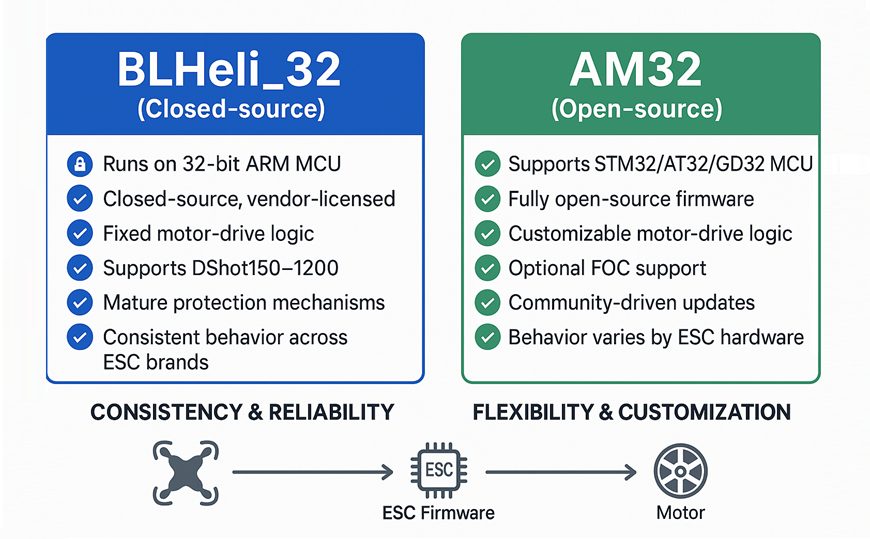
What is BLHeli_32?
1. Introduction to BLHeli_32 Firmware
BLHeli_32 is a commercial, closed-source ESC firmware running on 32-bit microcontrollers (typically the ARM Cortex series). Developed by the BLHeli team, it is the highest generation version of the BLHeli series firmware. Thanks to its mature and stable drive algorithms, extensive hardware compatibility, and comprehensive protection mechanisms, BLHeli_32 has long been the industry standard in the FPV drone field.
2. The Evolutionary Path of the BLHeli Series
The BLHeli series originated in the amateur model aviation field, evolving from early 8-bit MCU firmware.
BLHeli (1st Generation)
Runs on simple 8-bit MCUs, providing basic motor drive functions, suitable for early multirotor platforms.
BLHeli_S (2nd Generation)
Introduced more efficient drive algorithms, improved PWM frequencies, and smoother throttle linearity, making it the mainstream firmware for FPV racing drones from 2016–2018.
BLHeli_32 (3rd Generation)
Fully based on 32-bit processors, offering significantly improved performance. It supports higher refresh rates and more protocols, and features software protection, telemetry, and programmable characteristics, becoming the standard configuration for modern FPV ESCs.
This generation-by-generation evolution reflects the continuous optimization of motor control precision, response speed, and protection capabilities.
3. What are the Technical Features of BLHeli_32?
32-bit Processor Architecture
BLHeli_32 uses high-performance 32-bit MCUs, enabling the ESC to handle more complex control algorithms and maintain stability during high-speed operation.
High-Speed Refresh Rate
The firmware achieves higher PWM and drive frequencies, driving significant improvements in FPV throttle response and control precision.
Support for DShot150/300/600/1200
BLHeli_32 was one of the first mainstream firmwares to fully support DShot1200. As a digital throttle protocol, DShot offers advantages such as strong anti-interference capabilities and high signal consistency, making it a standard configuration for FPV racing and Freestyle platforms.
Complete Protection Mechanisms
The firmware has multiple built-in safety logics, including: Over-current protection, Over-temperature protection, Startup protection, and Voltage monitoring mechanisms. These protection strategies reduce the risk of damage under extreme conditions such as high-load flight, crashes, or short circuits.
Rich Adjustable Parameters
Through the BLHeliSuite32 tool, users can adjust numerous detailed parameters such as startup power, PWM frequency, braking force, throttle curves, and motor direction, allowing BLHeli_32 to achieve stable performance across different flying styles.
4. Ecosystem and Application Scenarios of BLHeli_32
BLHeli_32 has become the mainstream firmware system in the FPV ecosystem, possessing mature compatibility and extensive commercial application.
FPV Racing and Multirotor Platforms
Whether it is a 5-inch racing drone, a Freestyle machine, or a mid-sized cruiser platform, BLHeli_32 can provide stable and reliable response.
The Default Choice for Most Renowned ESC Manufacturers
Currently, the vast majority of mid-to-high-end ESC manufacturers on the market adopt BLHeli_32. This includes platforms such as: T-Motor, iFlight, Aikon, Spedix, etc. This ecosystem advantage makes it easier for users to obtain consistent performance experiences, mature parameter tuning methods, and comprehensive after-sales support.
What is AM32?
1. Introduction to AM32 Firmware
AM32 is a completely open-source firmware designed for brushless ESCs, primarily running on 32-bit microcontrollers such as STM32 and AT32. Unlike the commercialized BLHeli_32. AM32 adopts an open-source approach, allowing developers to freely compile, modify, and extend functions. With its high flexibility, wide hardware adaptation range, and significant cost advantages, AM32 has become the most discussed open-source firmware system in the FPV and multirotor fields over the past two years.
2. Background of AM32's Emergence
BLHeli_32 has long dominated the FPV industry, but its licensing model means manufacturers must pay fees for every unit of firmware and strictly adhere to the restrictions of a closed-source ecosystem. To a certain extent, this model increased the overall cost of ESCs and limited the space for some manufacturers regarding custom functions and secondary development.
In this context, AM32 emerged as an open-source firmware project, providing another path for the ESC ecosystem: no licensing fees, free modification of firmware logic, and adaptation to a wider range of hardware platforms. Its openness has enabled many small and medium-sized brands to lower hardware costs and has attracted a large number of developers and DIY users to participate in improvement and testing.
3. Technical Features of AM32
Supports Multiple Drive Protocols (DShot, PWM, FOC)
AM32 is compatible with mainstream digital and analog throttle protocols and includes the increasingly popular FOC (Field Oriented Control) mode, which makes motor operation smoother, quieter, and provides better low-speed performance.
Free Compilation / Custom Functions
Users can compile the firmware themselves according to actual needs, including: adjusting drive frequencies, optimizing startup algorithms, modifying protection logic, and adding experimental functions. This is of significant value to R&D personnel and enthusiasts.
Supports More Low-Cost MCUs
AM32 does not rely on high-end processor platforms, so it can run on a variety of lower-cost 32-bit chips. This provides manufacturers with greater hardware flexibility, allowing certain high value-for-money ESCs to enter the market at a lower cost.
4. Ecosystem Characteristics of AM32
Community-Driven, Rapid Iteration
AM32 is maintained entirely by the community. Its update cycle is fast, and function expansion is flexible; all types of developers can submit improvement proposals. This has enabled AM32 to achieve rapid growth from experimental firmware to mature application in a short time.
Mass Adoption by Small and Medium ESC Brands
Many emerging manufacturers adopt AM32 to lower firmware licensing fees in order to improve cost competitiveness, making it easier to launch product lines covering different specifications and price points.
Highly Active DIY Players
Because the firmware is open, users can flash different versions themselves, try personalized parameter combinations, and even participate in code optimization. Therefore, AM32 is very popular in the DIY modification circle, low-cost long-range platforms, and experimental drone projects.
BLHeli_32 vs AM32: What are the Differences?
Both BLHeli_32 and AM32 have become mainstream firmware systems in the current multirotor and FPV ESC market, but there are essential differences in their architecture, functions, ecosystem, and application positioning. The following content will expand on a systematic comparison from multiple dimensions to provide a more targeted reference for users with different needs.
Comparison Aspect | BLHeli_32 | AM32 |
System / Architecture | Commercial closed-source; requires licensing; highly consistent performance | Fully open-source; free to modify and port; performance varies by vendor implementation |
Throttle Protocols | Stable support for DShot150/300/600/1200 | Supports DShot, PWM, and FOC; compatibility depends on porting quality |
FOC Support | No FOC support; uses traditional six-step commutation | Supports FOC (experimental/vendor-optimized); smoother low-RPM performance and lower noise |
Protection Mechanisms | Mature over-current, over-temperature, voltage and startup protections; proven in long-term use | Basic protections available, but consistency depends on hardware and firmware version |
Motor Drive Logic | Consistent startup, stable throttle linearity, strong high-speed response | Fully customizable drive logic, PWM frequency and PID behavior |
Telemetry & Peripherals | Standardized support for RPM telemetry, LEDs and buzzer; high compatibility | Telemetry and peripherals supported but implementation varies across ESCs |
Stability & Reliability | Widely validated in racing, freestyle and commercial platforms | Stability depends on MCU and vendor tuning; quality varies between products |
Ecosystem Compatibility | Highly compatible with Betaflight, INAV, KISS and ArduPilot | Ecosystem developing quickly; generally compatible but version gaps may affect experience |
Cost / Licensing | Requires paid firmware licensing; increases ESC cost | Completely free; enables more cost-effective ESC products |
Customization | Limited tuning options; core logic cannot be modified; plug-and-play experience | Fully compilable and modifiable; ideal for R&D and advanced DIY users |
Target Use Cases | High-performance and commercial drones requiring consistency and reliability | Cost-sensitive platforms, long-range setups, experimental builds and DIY applications |
1. Differences in Technical Architecture
BLHeli_32 is a mature commercial closed-source system
The core code of BLHeli_32 is not public, and manufacturers need to use it via licensing. This closed mechanism brings highly consistent firmware quality, standardized development processes, and stable compatibility, but it also limits the freedom of secondary development.
AM32 is completely open-source
AM32 provides complete source code, and developers can freely modify, compile, and port the firmware. Its open mechanism brings vast customization space for manufacturers and players, but actual ESC performance may vary depending on the quality of porting and tuning.
Conclusion: Closed-source firmware emphasizes consistency and stability; open-source firmware provides more freedom and scalability.
2. Functional Differences
DShot Support
Both support mainstream DShot protocols, but BLHeli_32 is more mature in terms of compatibility and stability. AM32's support capability depends on the specific hardware and ported version, and performance may vary.
FOC (Field Oriented Control) Mode
AM32 supports experimental or manufacturer-optimized FOC modes, which can gain advantages in low-speed operation, silence characteristics, and efficiency performance; BLHeli_32 currently still relies mainly on the traditional six-step commutation method, emphasizing response speed and transient performance.
Maturity of Protection Mechanisms
BLHeli_32 is configured with comprehensive and strict over-current, over-temperature, startup, and voltage protection strategies, verified by large-scale commercial use; AM32 possesses basic protection functions, but specific behaviors depend on manufacturer porting and community versions, making its maturity relatively less consistent than BLHeli_32.
Motor Drive Logic
BLHeli_32 performs stably in throttle linearity, startup consistency, and high-speed response; AM32 offers more open tuning space, allowing developers to adjust PID drive logic, PWM frequencies, etc., giving it potential advantages in specific scenarios.
LED, Buzzer, RPM Telemetry
Both support RPM Telemetry, but BLHeli_32 performs more stably in standardization and compatibility; AM32 supports more flexible peripheral definitions, but implementation methods are not entirely consistent.
3. Stability and Reliability Comparison
BLHeli_32
Having undergone years of large-scale FPV application verification, its stability has become the industry standard. Whether in racing, Freestyle, or commercial mission platforms, BLHeli_32's consistency and reliability stand out in actual use.
AM32
Stability depends on the firmware version, MCU type, and manufacturer tuning capability. High-quality implementations of AM32 ESCs can achieve good performance, but there is greater variation between different products on the market, requiring user discrimination.
4. Ecosystem and Compatibility Differences
BLHeli_32
Highly compatible with mainstream flight controller ecosystems (Betaflight, INAV, KISS, ArduPilot, etc.), and is mature and comprehensive in parameter recognition, protocol support, and debugging tools.
AM32
The ecosystem is still developing rapidly. Compatibility is generally good, but ported versions from different manufacturers may have detailed differences, resulting in an experience that is not as comprehensively consistent as BLHeli_32.
5. Cost and Licensing Model
BLHeli_32
Adopts a paid licensing model. The firmware cost is borne by the ESC manufacturer, so the price of mid-to-high-end ESCs includes the firmware licensing fee.
AM32
Completely free and open-source, requiring no licensing. This significantly reduces the firmware cost of ESCs, enabling more manufacturers to launch high value-for-money products.
6. Playability and Customizability Comparison
BLHeli_32
Provides limited adjustable parameters, but internal logic cannot be modified, leaning towards a "Plug and Play" user experience.
AM32
All source code can be modified. Players can experiment with different drive strategies, or even develop custom firmware versions, making it a popular choice for DIY and experimental platforms.
7. Market Positioning Differences
BLHeli_32
More suitable for users pursuing high performance, stability, and consistency, such as racing drones, Freestyle, and commercial-grade drones.
AM32
More suitable for users who prioritize cost, need custom functions, or prefer trying new features, such as long-range platforms, small/medium factory ESCs, and DIY enthusiasts.
Which Firmware is Suitable for Your Drone?
BLHeli_32 and AM32 each possess clear technical characteristics and ecological positioning. Therefore, their suitability varies significantly under different flight scenarios and usage requirements. This chapter will provide users with a clearer direction for firmware selection starting from typical application needs.
1. Users Suitable for BLHeli_32
FPV Players Pursuing Stability and Consistency
For high-intensity flight scenarios like Racing and Freestyle, throttle response, dynamic stability, and error tolerance are crucial. BLHeli_32 has significant advantages in drive logic, protection strategies, and consistency between ESCs, maintaining reliable performance during extreme acceleration, sudden stops, or sharp turns.
High-Frequency Flying and Competitive Environments
Racing groups often face high temperatures, high currents, and long-duration high-load operation. BLHeli_32's mature over-current protection and drive strategies can effectively reduce the risk of ESC damage, making it suitable for equipment configurations verified over the long term in tournament environments.
High-Performance 5-inch and 6-inch Platforms
These platforms have high requirements for throttle resolution, transient response, and high-speed commutation capabilities. BLHeli_32's high-speed digital protocols, stable drive curves, and extensive debugging tools can provide higher consistency.
Commercial-Grade Drone Manufacturers
For commercial products, controllability, reliability, and after-sales consistency are core requirements. The closed system of BLHeli_32 guarantees stable firmware behavior, making it more suitable for mass-production drone systems.
Users Who Value an "Out-of-the-Box" Experience
BLHeli_32's default parameter tuning widely adapts to various FPV scenarios without requiring excessive custom configuration, suitable for user groups hoping to quickly obtain a stable experience.
2. Users Suitable for AM32
ESC Manufacturers Prioritizing Cost and Hardware Flexibility
AM32 can run on multiple MCU platforms and waives firmware licensing fees, allowing manufacturers to reduce costs and expand product arrays, particularly forming a competitive edge in the mid-range market.
Players Who Like Custom Firmware and Tuning
AM32 is completely open-source, allowing free modification of code logic, drive parameters, and protection mechanisms. It is very suitable for users pursuing experimental drive strategies or wishing to participate in firmware development.
Long-Range (LR) and Low/Medium Load Platforms
For models that do not emphasize extreme thrust response but target efficiency, low noise, or endurance, AM32's tuning flexibility allows for more personalized performance settings.
R&D Personnel and DIY Makers
Users who need to recompile or port the ESC, or perform deep integration with self-developed flight control systems, can flexibly adjust the firmware structure via AM32 to better adapt to experimental or prototype development needs.
Future Development Trends of BLHeli_32 and AM32
The development of ESC firmware not only affects the performance of the aircraft but also deeply influences the product form, cost structure, and technological roadmap of the drone industry. Looking at the current ecosystem and technology trends, BLHeli_32 and AM32 each have clear development trajectories and will continue to coexist in the foreseeable future.
1. BLHeli_32 Will Continue to Dominate High-Performance and Professional Fields
BLHeli_32 has already established a solid industry foundation in FPV racing, Freestyle, and some commercial drone fields. Its mature drive strategies, strict protection mechanisms, and long-term optimized parameter models make it remains the first-choice firmware for high-performance platforms.
Future trends include:
Maintaining a dominant position in 5–7 inch FPV and high-power platforms;
Continuing to strengthen DShot stability, response speed, and protection logic;
Maintaining advantages in professional equipment, especially scenarios with strict reliability requirements;
Although its closed-source model makes innovation speed less flexible than open-source firmware, maturity and consistency remain BLHeli_32's core competitiveness.
2. AM32 Will Still Grow Rapidly
AM32's open-source ecosystem has attracted a large number of manufacturers and developers, causing it to expand rapidly in the past two years, especially forming obvious competitiveness in the mid-range and high cost-performance ESC markets. Its technical route leans more towards open innovation, including FOC support, personalized drive algorithms, and a highly free parameter framework.
Future trends include:
Further expansion in the low-to-mid cost ESC market;
Continuing to attract developers to drive innovations in directions like FOC and energy efficiency optimization;
Becoming an important firmware option for DIY, scientific research, and customized drone systems;
As the community improves adaptation and tuning mechanisms, the overall stability of AM32 is also constantly improving, and its potential application range will expand further.
3. The Two Will Coexist Long-Term
From an industry structure perspective, BLHeli_32 and AM32 are not mutually exclusive replacements but cover different demand tiers:
BLHeli_32: Emphasizes maturity, stability, and professional application scenarios.
AM32: Emphasizes openness, flexibility, and cost advantages.
This differentiated positioning allows the two to form a complementary relationship rather than direct competition. It is expected that both firmware systems will continue to develop in parallel for many years to come.
4. Next-Generation ESC Technology Trends
Regardless of the firmware system, the ESC technology roadmap has shown several clear trends:
Popularization of FOC (Field Oriented Control)
FOC driving can significantly reduce noise, improve low-speed performance, and enhance efficiency. It will gradually become an important direction for high-end ESCs in the future.
Intelligent ESCs
With the improvement of MCU performance and enhanced linkage with flight controllers, ESCs may add more intelligent features, such as: real-time power monitoring, failure prediction, adaptive drive strategies, and more comprehensive telemetry data.
Support for Higher Voltage and Larger Current Platforms
As FPV and industrial drones continue to increase power demands, high-voltage and large-current platforms will promote firmware to further strengthen protection mechanisms and drive strategies.
Coexistence of Open Source and Commercial Firmware
Commercial firmware emphasizes consistency and reliability; open-source firmware promotes functional innovation and hardware popularization. The combination of the two will continue to drive the development of ESC technology.
Frequently Asked Questions (FAQ)
Q1. Why is the experience different with BLHeli_32 ESCs from different brands?
Although the firmware is exactly the same, the ESC's drive circuitry, heat dissipation methods, copper foil thickness, and MOSFET specifications differ, which affects the firmware's response speed and temperature rise performance during operation. Under high loads or rapid throttle changes, these hardware differences are amplified, so users will feel differences in "handling" between different brands of ESCs even under the same firmware.
Q2. Which firmware is more reliable in extreme temperature environments?
In extreme temperatures, the key lies in whether the firmware's protection logic is consistent and controllable. BLHeli_32's protection trigger methods are fixed and have been verified by massive applications, so its behavior is easier to predict in uncontrollable environments like high heat, large temperature differences, or outdoors; while AM32 is flexible, different versions or configurations may result in slightly different performance.
Q4. Will flashing AM32 affect ESC lifespan?
Flashing the firmware itself will not damage the ESC. However, using untested versions or adjusting aggressive protection parameters may cause the ESC to work under higher pressure, thereby indirectly affecting its lifespan. Adopting mature versions and maintaining default configurations usually carries no risk, so for most users, using AM32 will not have a practical impact on lifespan.
Q5. Can I mix BLHeli_32 and AM32 on the same flight controller?
As long as the same throttle protocol is used, both firmwares can run simultaneously. However, due to different startup logic and throttle processing methods, motor response may be slightly inconsistent after mixing, especially noticeable during arming or sudden acceleration. For racing drones or mission platforms requiring unified power characteristics, mixing is not recommended; test drones or casual players can use them normally.
Q7. Why is AM32 often chosen for Long Range platforms?
Long Range relies more on low-speed efficiency and energy consumption optimization. AM32 provides adjustable PWM, FOC modes, and more flexible drive strategies, which help improve low-speed smoothness and reduce power consumption. For flight missions with a high proportion of cruising, the accumulation of these minor optimizations can significantly extend endurance, so AM32 is more adopted by Long Range models.
Q8. Why do commercial drones prefer BLHeli_32?
Commercial platforms require firmware behavior to be stable, consistent, and easy to deploy in batches. BLHeli_32's firmware logic is fixed, version control is strict, and parameters cannot be modified at will, making its performance more predictable and easier to pass commercial verification processes. For enterprises, this consistency is more important than freedom, so BLHeli_32 holds the advantage in commercial scenarios.
Q9. Why is it said that AM32 has higher requirements for ESC hardware?
AM32 supports more modes and flexible drive strategies, while different ESCs have obvious differences in drive capability and design margins. If the circuits of certain ESCs are not optimized for high-frequency PWM or FOC, they may approach their limits more easily when running AM32. thereby showing more obvious heating or protection triggering. Therefore, the requirement is not the firmware itself, but that the hardware must be able to withstand richer control methods.
Recommended Reading:
Best Drone ESCs 2025: Top 10 Expert Picks
Previous Post : TOP 9 Tiny Whoop Motors 2025 (65mm & 75mm Whoops)