
In a drone's power system, the Speed Controller is the most critical bridge between the flight controller and the motor. It is also professionally referred to as an ESC (Electronic Speed Controller). Whether for small recreational drones or industrial-grade platforms requiring long endurance and high reliability, the Speed Controller undertakes the task of translating flight controller commands into actual thrust—that is, it determines how the motor responds, accelerates, and maintains stable RPM, ultimately deciding the smoothness, safety, and efficiency of the flight.
What is a Drone Speed Controller
Drone flight relies on the collaborative work of multiple core components, among which the Drone Speed Controller is the key module connecting "Flight Controller Commands" and "Motor Power." Whether it is a small recreational drone, aerial photography equipment, or an industrial drone requiring long-term stable operation, the Speed Controller is a fundamental component of the power system.
1. The Main Function of a Drone Speed Controller
The Drone Speed Controller is the core device for controlling the operation of brushless motors. It receives commands from the Flight Controller and outputs electrical energy of varying intensities to the motor according to demand, causing the motor speed to change accordingly.
Its main functions include:
●Regulating motor speed to enable the drone to perform actions such as ascending, descending, moving forward, moving backward, and turning.
●Maintaining stable power output to keep the drone in a steady attitude during flight.
●Simultaneously regulating the speed of multiple motors to achieve the attitude control requirements of multi-rotor aircraft.
In other words, the function of the Speed Controller is to convert the Flight Controller's commands into power changes executable by the motor.
2. The Position of the Speed Controller Within the Drone Power System
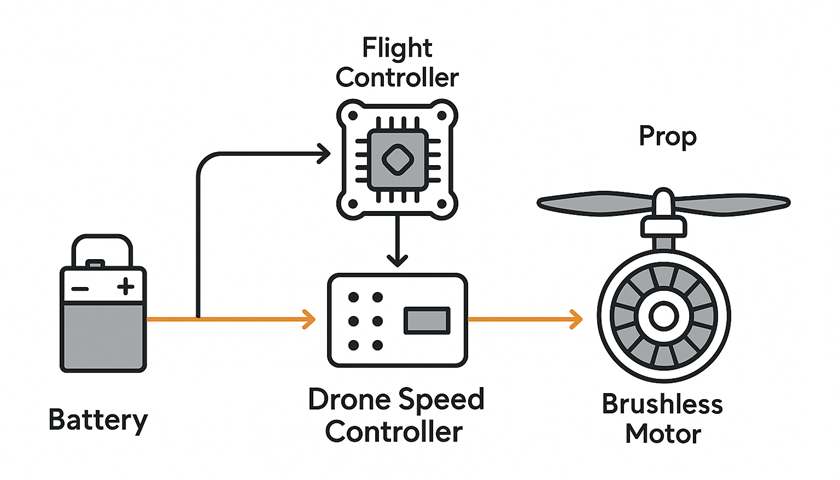
In a drone's power system, the Speed Controller is located between the battery and the motor. It is the core node for energy conversion and regulation: Battery → Speed Controller → Motor → Propeller.
The actual link should be understood as:
Battery: Responsible for providing electrical energy.
Speed Controller: Regulates electrical energy output.
Motor: Generates power based on the electrical energy output from the Speed Controller.
Propeller: Converts the motor's power into aerodynamic thrust.
In the control link, the sequence is:
Flight Controller: Command Input.
Speed Controller: Power Regulation.
Motor: Power Execution.
The Flight Controller is responsible for determining the power adjustments needed for attitude changes and flight maneuvers. The Speed Controller adjusts the output based on the Flight Controller's judgment, causing the motors to run at different speeds. Therefore, it serves as an important bridge between the control system and the power system.
3. How Battery Power Is Converted Into Motor Power
Drone brushless motors cannot directly use the direct current (DC) provided by the battery. The task of the Speed Controller is to convert DC into three-phase alternating signals capable of driving the motor.
The basic process includes:
●The battery provides DC power to the Speed Controller.
●The Speed Controller internally supplies power to the three sets of motor windings alternately according to a specific rhythm.
●This alternating power supply creates a rotating magnetic field inside the motor, thereby driving the motor to rotate continuously.
From a layman's perspective, the Speed Controller can be viewed as an electrical regulation device that "adjusts battery energy into power usable by the motor."
4. How Flight Controller Commands Become Motor RPM
The Flight Controller monitors the drone's attitude and flight status in real-time and calculates the target RPM required for the motors based on control commands. The Speed Controller then performs the following operations based on these commands:
●Receives the throttle signal sent by the Flight Controller.
●Parses the signal and adjusts the internal current regulation strategy.
●Outputs current of varying intensity to increase or decrease motor speed.
For example:
●When the drone needs to ascend, the Flight Controller sends a higher target RPM command to all motors.
●When the drone needs to turn, the Flight Controller adjusts the speed of specific motors, causing the aircraft to perform the corresponding rotational maneuver.
●The response speed and accuracy of the Speed Controller directly affect the smoothness of flight maneuvers, the handling experience, and flight safety.
Types of Drone Speed Controllers and Their Typical Uses
The form of a Drone Speed Controller varies depending on the drone's size, purpose, and structural layout. Although all Speed Controllers share the core responsibility of regulating motor speed, their appearance, integration level, and mounting methods can differ significantly across different types of drones. Understanding common Speed Controller types helps in making more accurate judgments when selecting and maintaining the right solution for your drone platform.
1. Individual Speed Controllers
Individual Speed Controllers refer to a setup where each motor is equipped with a separate controller. This method is common in large, heavy-lift, or long-endurance drones, such as: Industrial inspection drones, agricultural spraying drones, heavy-lift transport drones, and long-endurance mapping platforms.
Its main features include:
Independent structure, better heat dissipation
Each controller has its own space for heat dissipation, avoiding extra heat accumulation caused by multi-channel integration. For operational drones with continuous high current output, an independent structure helps maintain temperature stability.
Higher current handling capability
Individual controllers typically feature larger current specifications, wider heat dissipation surfaces, and more ample space for power wiring, making them more suitable for bearing heavy workloads.
More flexible maintenance and replacement
When one controller malfunctions, it can be replaced individually without affecting the running structure of other motors; this facilitates engineering maintenance and future upgrades.
Suitable for large frames with ample space
Since installation locations must be allocated for multiple controllers, this is more suitable for drones with wider arms and larger frame dimensions.
Overall, individual Speed Controllers emphasize high reliability, high durability, and maintainability, making them the mainstream configuration for many industrial-grade drones.
2. 4-in-1 Speed Controllers
4-in-1 Speed Controllers integrate four channels onto a single circuit board. This is the most common design in multi-rotor drones, especially prevalent in the following scenarios: FPV racing drones, aerial photography drones, small portable drones, and lightweight drone platforms.
Its main features include:
Compact structure, space-saving
Four Speed Controllers are integrated on the same substrate, making the overall size significantly smaller than the sum of four individual controllers. This offers an advantage for models with tight fuselage space.
Cleaner wiring, easier installation
Since all channels are concentrated in one location, power and signal wiring is much simpler, reducing the complexity of internal cabling.
Lower weight, improving flight efficiency
Compared to using four independent controllers, the 4-in-1 structure is lighter, which helps improve flight time and maneuverability, making it particularly suitable for FPV and aerial photography drones.
Different maintenance method
The downside of the 4-in-1 structure is that if one channel is damaged, the entire board usually needs to be replaced, making it less flexible than the individual solution. However, for consumer drones and FPV drones, this maintenance method is still relatively common.
Overall, 4-in-1 Speed Controllers pursue higher integration and a more compact overall layout, suitable for small drones requiring lightweight and simplified structures.
3. How to Choose Between Individual and 4-in-1 Controllers
When choosing between individual and 4-in-1 Speed Controllers, one should comprehensively consider factors such as drone size, structure, current requirements, and maintenance methods. Generally, judgments can be made from the following aspects:
Based on current demand
High current demands, long-duration work, large propellers, or heavy-lift platforms are better suited for individual controllers to achieve better heat dissipation and durability. Small to medium drones and recreational aircraft tend to favor 4-in-1 controllers as long as they meet the requirements.
Based on frame space layout
Large frames have ample space to arrange independent controllers for each motor; small frames have tight space, making the 4-in-1 structure more reasonable.
Based on maintenance method
Individual units are easy to replace channel by channel, suitable for industrial drones requiring long-term operation. 4-in-1 units fit a whole-replacement mechanism with controllable maintenance costs, suitable for FPV and aerial photography drones.
Based on usage scenario
Flight time, load type, and flying style will all affect the choice of controller.
For example:
Industrial Drones: Pursue reliability and durability → Indivudal ESCs are more suitable.
FPV Drones: Pursue lightweight and spatial efficiency → 4-in-1 ESCs are more suitable.
Camera Drones: Often choose 4-in-1 to improve internal layout neatness.
Individual vs 4-in-1 Drone Speed Controller Comparison:
Item | Individual Drone Speed Controller | 4-in-1 Drone Speed Controller |
Typical Platforms | Industrial UAVs, heavy-lift | FPV, aerial photography, compact drones |
Cooling Performance | ⭐⭐⭐⭐ | ⭐⭐⭐ |
Current Capacity | High | Medium–High |
Wiring Complexity | Higher | Very low |
Weight | Slightly heavier | Lighter |
Maintenance | Replaceable per channel | Often replaced as a whole |
Space Requirement | Larger | Minimal footprint |
Key Technical Specifications of Drone Speed Controllers
When selecting and understanding a Drone Speed Controller, you need to pay attention to several key technical parameters. They determine the maximum workload the controller can withstand and also affect power response, stability, and safety during flight. The following provides a clear, easy-to-understand explanation of common key indicators to help readers accurately judge whether a Speed Controller is suitable for their drone.
1. Voltage
Drone LiPo (Lithium Polymer) batteries use "S" to indicate the number of cells in series, such as 3S, 4S, 6S, 8S, 12S, etc. The Speed Controller must be able to withstand the voltage level provided by the battery; otherwise, issues like failure to start, overheating, or even damage may occur.
Meaning of Voltage Levels:
●3S (approx. 11.1V): Commonly used for small aircraft.
●4S and 6S: More common in FPV racing drones, aerial photography drones, and some industrial drones.
●Higher Voltage: Allows the motor to achieve higher maximum RPM and stronger instantaneous response.
Voltage Support Range:
●Different Speed Controllers will label their maximum supported voltage, e.g., "2S–6S".
●When selecting a Speed Controller, you must ensure it supports the battery voltage used by the drone; do not lower the standard.
Impact of Voltage on Performance:
Higher voltage means higher thrust potential, but it also brings higher current impact, so the overall design of the Speed Controller must be robust enough.
2. Continuous Current vs Peak Current
Speed Controller current specifications usually consist of two values: Continuous Current and Peak Current.
Continuous Current
Refers to the maximum current the Speed Controller can stably withstand during long-term operation. It is the most critical indicator for measuring the durability and cooling performance of the Speed Controller.
Peak Current
Refers to the higher current the Speed Controller can tolerate for a short time (usually a few seconds). Peak current is used to handle instantaneous actions like acceleration and sudden stops but cannot be maintained for long.
Why reserve headroom (redundancy)?
In actual flight, motor current changes constantly with the load. To prevent accidental overload and rapid temperature rise, Speed Controller specifications usually need to be about 20% to 30% higher than the motor's maximum current.
How to determine if the spec is sufficient?
Simply ensure the Speed Controller's continuous current is greater than the maximum current generated by the motor under the condition of the propellers used. Peak current should serve as a backup protection and not be relied upon for long periods.
3. Control Signal Protocols
When the Flight Controller sends commands to the Speed Controller, it uses different signal protocols. Different protocols have their own characteristics in terms of precision, latency, and stability.
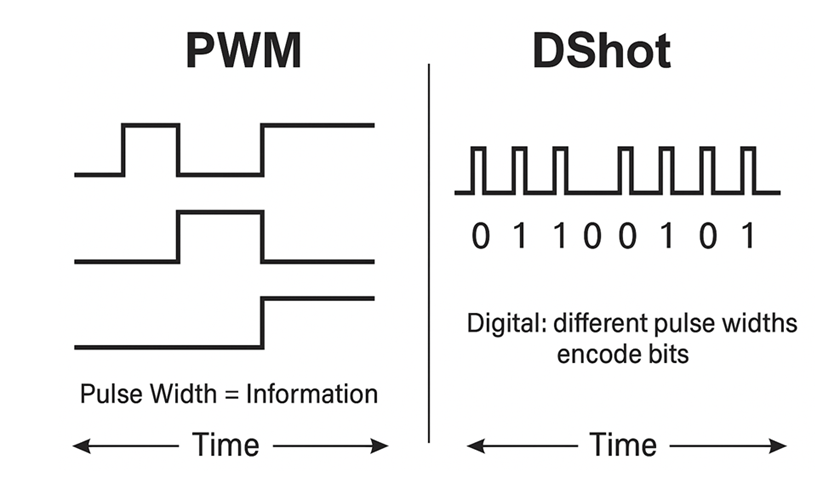
PWM
The traditional method. The update speed is slower, but it can meet the needs of the vast majority of industrial drones. Industrial ESCs usually have built-in higher precision closed-loop control (such as FOC), so the reliance on external signal refresh rates is lower, and PWM is still widely used.
OneShot and MultiShot
Faster than PWM with more sensitive response, mostly used in early FPV systems, now less commonly used.
DShot (Digital Signal Protocol)
One of the most mainstream control protocols currently. Its main features include:
Stable signal transmission, immune to line noise interference.
●No calibration required.
●Higher control precision.
●Faster response speed.
For drones pursuing fast response and high maneuverability, DShot is usually the priority choice.
4. MOSFETs, Copper Thickness, and PCB Structure
The internal structure of the Speed Controller plays an important role in its heat dissipation capability, load-bearing capacity, and overall stability.
Importance of MOSFETs
MOSFETs are semiconductor components inside the Speed Controller responsible for switching current. Higher quality means lower power consumption, less heat generation, and higher overall efficiency.
PCB Copper Foil Thickness
Thicker copper foil can withstand higher current and maintain better heat dissipation capabilities. For high-current Speed Controllers, using thickened copper foil can significantly improve reliability.
Multi-layer PCB Design
Some high-quality Speed Controllers use multi-layer circuit boards, making current paths shorter and less complex, which helps reduce resistance and heat generation.
FOC Technology
Some high-end Speed Controllers introduce FOC (Field Oriented Control) technology, which can achieve smoother speed control and quieter motor operation. Its advantages are obvious, but the cost is higher.
5. Size, Mounting Patterns, and Cooling Design
The shape and mounting method of the Speed Controller must be compatible with the drone frame.
Common Sizes and Hole Spacing:
●Small drones commonly use 20 x 20 mm structures.
●FPV and most camera drones commonly use 30 x 30 mm.
●Industrial drones possess larger dimensions to carry higher current.
Different hole spacing formats determine whether the Speed Controller can be successfully installed on the frame, so compatibility must be confirmed in advance during selection.
Importance of Heat Dissipation Structure:
The larger the current and the higher the load, the more heat the Speed Controller generates. Excellent cooling design includes:
●Large-area copper heat dissipation layers.
●Layouts that align with airflow direction.
●Combination with metal heatsinks or thermal silicone pads.
●Good airflow environment within the arm.
●The better the heat dissipation effect, the more the Speed Controller can stably withstand long-term high loads.
Drone Speed Controller Key Specifications Overview:
Spec | Meaning | Performance Impact | Common Range |
Supported Voltage | Max battery voltage allowed | Determines usable S levels | 2S–6S / 6S–12S |
Continuous Current | Sustained current capacity | Affects heat & durability | 20A–200A+ |
Peak Current | Short-burst handling | For punch-outs & hard maneuvers | 1.2–1.5× continuous |
Protocol | FC-to-controller communication | Defines latency & precision | PWM / DShot300–2400 |
MOSFET Quality | Determines heat & efficiency | Directly affects reliability | Vendor dependent |
PCB Copper Weight | Affects current handling | Thicker copper = higher load | 2oz–6oz |
Size / Mounting | Frame compatibility | Determines installation | 20×20 / 30×30 |
How to Choose the Right Speed Controller for Your Drone
Choosing the right Drone Speed Controller not only relates to flight performance and handling experience but also affects the long-term reliability and safety of the drone. From battery voltage to motor type, then to propeller load, cooling conditions, and usage scenarios, every factor affects the final selection result. The following will help readers establish a clear selection mindset through a concise and clear method based on practical use.
1. A Five-Step Selection Method
Speed Controller selection can be judged according to the following five steps, a process that is both universal and practical.
Step 1: Confirm Battery Voltage
The Speed Controller must be able to withstand the battery's voltage level, e.g., 3S, 4S, 6S. If the Speed Controller's support range is too low, it cannot operate normally and may even be damaged due to voltage overload.
Step 2: Check the Motor KV Value
The higher the KV value, the higher the current the motor needs at the same voltage. High KV motors usually require higher specification Speed Controllers to obtain sufficient instantaneous response.
Step 3: Estimate Current Demand Based on Propeller Load
The larger the propeller, the higher the load, and the greater the current the motor requires. Different propeller combinations will produce different currents under the same KV and voltage, so one should consult the motor manufacturer's thrust test data.
Step 4: Choose the Appropriate Control Protocol
Different protocols vary in response speed and stability. If stability is pursued, PWM is sufficient. If fast response is needed, DShot is more suitable. The choice of protocol does not change the load capacity of the Speed Controller but will affect the flight experience.
Step 5: Reserve Safety Headroom for Current Specs
It is generally recommended that the continuous current of the Speed Controller be 20% to 30% higher than the motor's maximum current. Such headroom can effectively avoid the risk of damage caused by temperature rise, sudden loads, or unstable battery voltage.
Through these five steps, users can judge more systematically which type of Speed Controller is best suited for their drone system.
2. Recommended Speed Controller Specs for Different Drone Types
Depending on the drone category and typical usage scenarios, Speed Controller specifications will vary. The following are general reference ranges for common platforms.
●5-inch FPV Drone
Battery: 4S or 6S
Motor KV: High KV
Spec: 35A to 55A
Note: 5-inch frames emphasize sensitivity and explosive power, thus requiring high instantaneous current handling capability.
●Cinewhoop (Stable Filming Drone)
Battery: 4S
Motor KV: Medium
Spec: 25A to 35A
Note: These drones focus on stability, with moderate requirements for Speed Controller load.
●7-inch Long-Range Drone
Battery: 4S or 6S
Motor KV: Low KV
Spec: 45A to 65A
Note: Long-range drones use large propellers, requiring high heat dissipation and continuous current capabilities from the Speed Controller.
●Industrial or Heavy-Lift Drone
Battery: 6S to 12S
Motor KV: Lower KV
Spec: 60A to 200A+ (Depends on load)
Note: Industrial drones need to withstand large thrust demands, so the Speed Controller must possess higher quality heat dissipation, stability, and redundancy design. The above data are typical ranges in the mainstream market; specific selection still needs to be judged based on actual motor and propeller parameters.
3. Common Mistakes When Choosing a Speed Controller
When purchasing a Speed Controller, novice users tend to overlook some key risk points. The following common issues deserve special attention.
Insufficient Current Specification
Many new users only focus on the appearance or brand of the Speed Controller but ignore its current handling capability. If the continuous current of the Speed Controller is insufficient, overheating, stalling, or even damage may occur.
Voltage Mismatch:
When using high-voltage batteries, if the Speed Controller's voltage rating is lower, it will not work properly and hardware failure may even occur.
Lack of Capacitor Protection
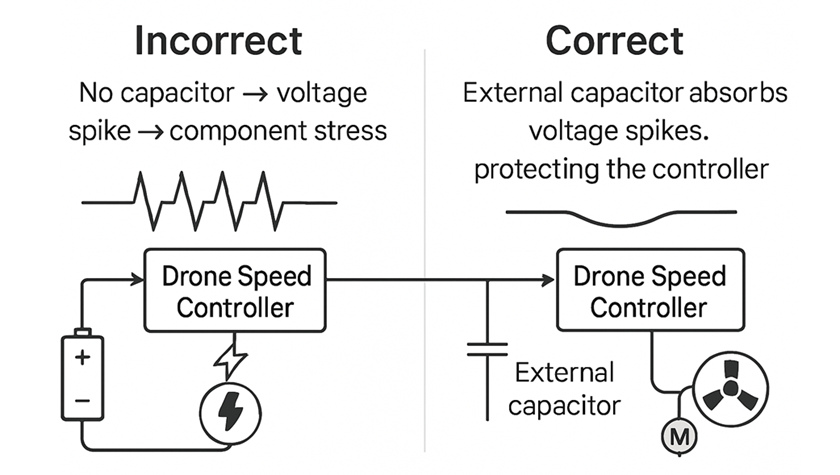
Speed Controllers are prone to generating voltage spikes under high load or sudden current changes. Using a capacitor can effectively reduce risk. Systems not equipped with capacitors are more prone to Speed Controller burnout or Flight Controller resets.
Insufficient Cooling Conditions
If the Speed Controller is installed in a location with poor airflow, especially in high-load scenarios, overheating problems are likely to occur.
Wrong Propeller Ratio Leading to Overload
Excessive propeller load will cause the motor current to exceed the Speed Controller's rated value. This is one of the risks most easily overlooked by novices, so thrust data must be consulted during selection.
Recommended Drone Speed Controller Specs for Common Drone Types:
Drone Type | Battery Voltage | Motor KV | Prop Size | Recommended Drone Speed Controller |
5" FPV Racing | 4S–6S | High KV | 5 inch | 35A–55A |
Cinewhoop | 4S | Medium KV | 3–4 inch | 25A–35A |
7" Long-range | 4S–6S | Low KV | 7 inch | 45A–65A |
Industrial / Heavy-Lift | 6S–12S | Low KV | 12–36 inch | 60A–200A+ |
Guide to Matching the Speed Controller With the Drone Power System
The Speed Controller is an important component of the drone power system. Its performance must be coordinated with the motor, propeller, battery, and flight controller signals to ensure the entire machine is stable and reliable in various flight modes. The following will start from the perspective of system matching to help readers more clearly understand the relationship between the Speed Controller and other key components, and provide typical matching examples for common drone platforms.
1. Matching the Controller With the Motor
The current handling capability of the Speed Controller is closely related to the characteristics of the motor. The motor's KV value, size, and load will all affect current demand. Therefore, when choosing a Speed Controller, you must ensure its specifications meet the motor's actual operating range.
Relationship between KV Value and Current Demand
The higher the KV value, the higher the motor speed at the same voltage, and the current demand increases accordingly. High KV motors are often used in scenarios requiring fast response, such as FPV racing drones, thus requiring higher specification Speed Controllers.
Relationship between Motor Size and Speed Controller Spec
Large-sized motors (e.g., with longer or wider stators) usually need to withstand higher loads, thus requiring Speed Controllers with higher current ratings. For industrial drones, the motor structure is large, and Speed Controllers typically feature larger heat dissipation areas and higher current handling capabilities in their design.
Importance of Motor Test Data
Motor manufacturers usually provide thrust test tables under different propeller and voltage conditions, which include maximum current values. These data are an important basis for judging whether the Speed Controller is sufficient and should be part of the selection reference.
2. Matching the Controller With the Propeller
The size and pitch of the propeller significantly affect the motor load. When the propeller size increases or the pitch increases, the motor needs to generate more torque, thereby consuming higher current.
Larger Propellers Require Higher Specs
Large propellers carry heavier loads at high speeds, causing motor current to rise rapidly. Therefore, it must be ensured that the Speed Controller specification can meet the current demand at maximum load.
Incorrect Ratio May Lead to Overload
When the propeller load exceeds the Speed Controller's capacity, abnormal heating, power drop, or even damage will occur. This is also a common risk point for novice users and must be carefully evaluated when selecting or changing propellers.
Propeller Load Differences in Different Drone Types
FPV propellers typically have medium load but require high instantaneous response; large aerial photography propellers emphasize stability and efficiency; industrial propellers are large in size and high in load, placing the strictest requirements on Speed Controller specifications.
3. Controller Compatibility With Flight Controller Protocols
The communication method between the Flight Controller and the Speed Controller directly affects the drone's handling experience and power response. Different protocols vary in refresh rate, signal stability, and latency.
PWM Protocol
Traditional control method, lower refresh speed, suitable for applications with low response requirements, such as some industrial drones.
OneShot and MultiShot
Older high-speed protocols, once widely used in FPV, but gradually reduced in use with the popularity of digital protocols.
DShot Protocol
The most common digital control protocol currently, featuring high signal stability, strong anti-interference ability, and no need for calibration.
For models requiring fast response, such as FPV and aerial photography drones, DShot has obvious advantages. When selecting, confirm whether the protocols supported by the Flight Controller are compatible with the Speed Controller to avoid issues with recognition failure or inconsistent response.
Drone Speed Controller Power System Matching:
Item | Impact | How to Match | Common Risks |
Motor KV | Higher KV increases current | Use motor thrust test max current; choose higher continuous current controller | Heat, desync, failure |
Motor Size (Stator) | Larger stator means higher load | Check motor’s max continuous current | Overload and heating |
Prop Size (Diameter/Pitch) | Larger props raise load | Refer to thrust test current values | Overcurrent, shutdown |
Battery Voltage | Higher voltage increases stress | Controller rated voltage ≥ battery voltage | Start failure, damage |
Flight Protocol (PWM/DShot) | Affects response and stability | Match FC and controller protocol | Jitter, poor response |
Cooling Conditions | Poor airflow reduces reliability | Mount in airflow or on arms | Overheating during long use |
External Capacitor | Reduces voltage spikes | Recommended for high-load drones | Voltage spike damage |
Best Practices for Using and Maintaining a Speed Controller
During the long-term use of drones, the Speed Controller not only needs to possess sufficient current handling capability and stable control performance but also requires reasonable installation methods, a good heat dissipation environment, and standardized maintenance habits.
The following introduces key points to improve Speed Controller stability, extend service life, and reduce failure risks from the practical perspective of use and maintenance.
1. Installation and Wiring Best Practices
Good installation and wiring methods help improve the stability and anti-interference ability of the Speed Controller and also reduce potential risks caused by vibration, metal debris, or loose solder joints.
Ensure Proper Power Wire Length and Gauge
If the power wire is too long, resistance and heat will increase; if the wire gauge is too thin, it may lead to overheating. Choosing the appropriate wire gauge based on operating current helps reduce loss and improve safety.
Secure Connection of Signal and Ground Wires
The signal wire of the Speed Controller should maintain a good connection with the Flight Controller, while ensuring the ground wire is always connected to avoid control anomalies caused by signal drift.
Avoid Metal Debris Accumulation or Contact
Metal debris can cause short circuits or damage components; keep the electronics bay or the interior of the arm clean. For FPV users, residual metal debris after soldering requires special attention.
Solder Joints Should Be Firm and Vibration-Resistant
Drones generate continuous vibration during flight. If solder joint strength is insufficient, cold solder joints (weak joints) or fractures may occur. Therefore, using an appropriate amount of solder and good soldering technique is very important.
2. Cooling Management and Environmental Considerations
Cooling performance determines the stability of the Speed Controller under continuous flight or high-load conditions. Good cooling management can reduce temperature rise, improve efficiency, and significantly extend component life.
Choose a Ventilated Location for Installation
Airflow is the most effective cooling method during flight. Especially for FPV racing drones, installing the Speed Controller on the outside of the arm or near airflow channels can improve cooling efficiency.
Cooling and Structure Matching for Industrial Drones
Industrial drones often have sealed or semi-sealed designs, requiring assurance that heatsinks and thermal conductive structures can effectively dissipate accumulated heat to meet long-term operational needs.
Impact of Environmental Temperature
High-temperature environments accelerate Speed Controller temperature rise, increasing the risk of thermal damage; low-temperature environments may affect component conductivity. Flight time and load should be adjusted according to the mission environment.
Notes on Humidity or Rainy Environments
Some users apply waterproof coatings to protect the Speed Controller, but note that coatings reduce heat dissipation efficiency and are not suitable for continuous high-current use. Industrial drones often use specialized protective structures to deal with humidity issues.
3. How to Extend the Lifespan of a Speed Controller
The key to extending the life of a Speed Controller lies in avoiding overload operation, reducing thermal stress, and ensuring reasonable overall system matching. The following methods can significantly reduce the probability of failure.
Adopt Sufficient Current Headroom
Keeping the Speed Controller within a safe current range during continuous work not only reduces heat generation but also lowers the risk of damage caused by sudden loads.
Use External Capacitors to Reduce Voltage Spikes
In high-load or large-propeller systems, voltage spikes are inevitable. External capacitors can effectively buffer this phenomenon, protecting the Speed Controller and Flight Controller.
Ensure Reasonable Motor and Propeller Matching
Incorrect propeller size or pitch will cause motor overload, keeping the Speed Controller in a sustained high-load state. Maintaining consistency in power system matching is an important prerequisite for extending Speed Controller life.
Regularly Check Solder Joints and Connecting Wires
Loose or oxidized solder joints can cause unstable current or local overheating. Critical connection points should be checked during maintenance cycles to ensure all interfaces are secure and reliable.
By taking the above measures, the reliability of the Speed Controller can be significantly improved, allowing the drone to remain stable and efficient during long-term operation.
Troubleshooting Guide for Drone Speed Controllers
The Speed Controller plays a critical role in the drone power system. Once an anomaly occurs, it may cause the motor to fail to start, flight control to become unstable, or even lead to flight interruption or loss of control in severe cases.
The following introduces common fault identification methods, troubleshooting workflows, and possible solutions from a practical usage perspective, helping users quickly locate causes and take appropriate measures when encountering problems.
1. Basic Troubleshooting Workflow
When dealing with issues related to the Speed Controller, inspection should proceed in an order from outside to inside, and from simple to complex. The following workflow helps quickly determine the location of the problem:
Check if power supply is normal
Confirm the battery is sufficiently charged and the power supply lines are not loose or making poor contact. If using a Power Distribution Board (PDB), also confirm solder joints are firm and show no signs of damage.
Check if the motor can spin freely
If the motor is stuck by foreign objects or the bearings are damaged, the Speed Controller may not be able to drive it normally; exclude such mechanical problems first.
Check if signal and ground wires are reliably connected
Looseness in any signal or ground wire will prevent the Speed Controller from correctly receiving Flight Controller commands, thereby affecting power output.
Observe for abnormal heating
If the Speed Controller heats up rapidly after powering on, there may be issues like short circuits, excessive load, or internal component damage; stop operation immediately.
Check for physical damage
Inspect the Speed Controller surface for burn marks, cracks, or desoldering, which helps determine if hardware failure has occurred.
Through these basic checks, the general scope of the problem can usually be confirmed, providing direction for further troubleshooting.
2. Motor Not Starting or Behaving Abnormally
This is one of the most common Speed Controller-related faults, potentially caused by the following types of reasons:
Signal transmission anomaly
If the Flight Controller cannot output commands correctly, or the signal wire contact is poor, the Speed Controller will not obtain correct data, leading to the motor failing to start or reacting sluggishly.
Solder joint or wiring issues
Weak soldering, oxidized lines, or damage will prevent the Speed Controller from stably supplying power to the motor; focus on checking solder joint quality and connector stability.
Internal component damage
If internal components of the Speed Controller fail due to overload or accidental damage, it will also manifest as failure to start. In this case, use a replacement Speed Controller for comparison testing.
During troubleshooting, gradually exclude signal, power, and hardware factors to determine the specific cause.
3. Overheating Issues
Speed Controller overheating usually occurs under high load or poor heat dissipation conditions. If not handled in time, it may lead to performance degradation or even damage.
Excessive load
Unreasonable propeller size, oversized motors, or excessive payload will cause a significant rise in current, keeping the Speed Controller in a high-temperature state for a long time.
Insufficient heat dissipation
If the Speed Controller is in a position with restricted airflow or surrounded by structures blocking airflow, the cooling effect will drop significantly.
Improper Propeller and KV matching
Wrong power combinations may cause current to exceed the Speed Controller's capacity; propeller size or Speed Controller specifications should be re-matched based on motor test data.
Power ripple issues
In some systems, insufficient capacitance or long wiring can generate voltage fluctuations, aggravating Speed Controller heating. Consider adding capacitors or improving wiring.
By checking current load, cooling structure, and power stability, the root cause of overheating can be effectively located.
4. Motor Jitter, Desync, or Noise Issues
Jitter, noise, or desync phenomena during motor startup or operation often reflect inconsistency between control signals and power output.
Control protocol mismatch
Using a protocol not fully supported by the Flight Controller or firmware may lead to unstable signal parsing. Try changing the protocol category and testing for improvement.
Motor load too high
When the motor load exceeds the Speed Controller's maximum capability, the RPM may fail to match its signal input, leading to desync or jitter.
Signal interference or wiring issues
If signal wires and power wires are wound too tightly, or wire layout is unreasonable, noise interference may result in unstable signals.
Motor body issues
Winding damage, bearing issues, or internal short circuits can also cause similar phenomena; check the motor for physical damage.
Checking protocols, loads, and wiring layouts usually effectively troubleshoots such issues.
5. Controller Burnout Causes and Prevention
Speed Controller burnout is one of the most severe faults in drones, with root causes usually related to load, voltage, or heat dissipation.
Damage caused by overcurrent
When motor current exceeds the Speed Controller's continuous current capability, internal components will be damaged due to overheating. Choosing a higher specification Speed Controller or reducing propeller load is key to avoiding overcurrent.
Impact caused by voltage spikes
The Speed Controller may encounter voltage shocks when bearing sudden loads. Without sufficient external capacitor protection, component damage may be triggered.
Acute damage caused by short circuits
Short circuits caused by poor line contact or metal foreign objects can lead to immediate damage; keep the fuselage interior clean and ensure solder joints are firm.
Thermal damage caused by poor heat dissipation
High temperatures accelerate component aging. If the Speed Controller is in a high-temperature environment for a long time, its service life will be significantly shortened.
Improper power system matching
If the combination of motor, propeller, battery, and Speed Controller is unreasonable, currents exceeding the design range may be generated during certain flight maneuvers, leading to Speed Controller damage.
Therefore, the key to preventing Speed Controller burnout lies in reasonable selection, ensuring good heat dissipation, timely checking wiring, and ensuring overall power system matching.
Frequently Asked Questions (FAQ)
Q1. Why do different brands both labeled 40A perform very differently in reality?
The same specification does not represent the same performance. Actual load capacity depends on MOSFET quality, PCB copper foil thickness, heat dissipation design, and firmware strategy. There are large differences in nominal standards across different manufacturers, so 40A controllers may perform completely differently under high loads.
Q2. Is it a fault if the Drone Speed Controller makes a high-pitched noise during acceleration or low speed?
Generally, it is not a fault, but a resonance sound produced by the controller and motor at specific frequencies. Winding structure, drive methods, PWM frequency, or FOC regulation can all cause slight noise. As long as the operation is smooth, without jitter or desync, there is no need to worry.
Q3. It is stable under no load, but jitters or desyncs after installing propellers. Why?
After installing propellers, the load increases sharply, and current fluctuations become larger. If the propellers are too big, the controller current is insufficient, the power supply is unstable, or parameters are unmatched, problems may be exposed. This is usually related to the load rather than a quality defect of the controller itself.
Q4. Why does a controller labeled as supporting 6S heat up more easily under 6S?
"Supporting 6S" only indicates sufficient voltage tolerance, but high voltage brings larger current impacts and RPM changes. If heat dissipation, MOSFETs, or current headroom are insufficient, the controller will heat up more easily under 6S.
Q5. Can different brands of Drone Speed Controllers be mixed?
They can be used, but it is not recommended. Different brands have significant differences in response speed, protocol processing, startup logic, and heat dissipation, which will cause inconsistent multi-motor output and affect attitude control. If mixing is necessary, ensure protocols, current specs, and drive methods are close, and test fully.
Q6. Why are Drone Speed Controller capacitors prone to damage? Is it really important?
Capacitors are used to absorb voltage spikes and stabilize power supply; they are the core of controller protection. In scenarios with large propellers, high currents, or frequent speed changes, voltage fluctuations are severe. If the capacitor's voltage tolerance is insufficient, it is easily damaged, and the lack of capacitor protection will significantly increase the risk of burnout.
Q7. Does the Drone Speed Controller need to be upgraded after the Flight Controller is upgraded?
It depends on changes in protocol and refresh rate. If the Flight Controller switches to a new digital protocol or enables new power management functions, the controller may need a synchronized upgrade or setting adjustment; otherwise, issues like non-linear throttle or abnormal response may occur.
Q8. Why is the Drone Speed Controller sometimes hotter at low throttle?
At low speeds, the controller needs to adjust the magnetic field frequently, and motor efficiency is also lower at low speeds, causing losses to concentrate more easily on the controller. If the load is on the high side or heat dissipation is poor, the temperature rise at low throttle may even be higher than at medium-high throttle.
Q9. Will applying conformal coating (three-proof paint) to the Drone Speed Controller affect heat dissipation?
Yes. Conformal coating will hinder the heat dissipation of MOSFETs, leading to higher temperatures. For high-current platforms, this heat accumulation may affect lifespan, so it is more suitable to use dedicated cooling structures rather than direct spraying.
Q10. If the controller has a slight burnt smell but looks normal, is it broken?
A burnt smell is not necessarily damage; it may be slight oxidation of flux or adhesive at high temperatures. If the temperature is normal, power is smooth, and there is no jitter or abnormal heating, it can generally continue to be used. However, if local temperature is abnormally high or instantaneous overheating occurs, stop using it immediately and check.
Recommended Reading:
Best Drone ESCs 2025: Top 10 Expert Picks
Previous Post : BLHeli_32 vs AM32 Firmware: How Do They Compare?